
Competitor Analysis for SaaS: A Step-by-Step Guide
Data-driven 6-step framework to find SaaS competitors, uncover SEO and pricing gaps, and build a SWOT-backed growth plan.

Want to grow your SaaS business faster? Companies that conduct competitor analysis regularly grow 2.5x faster than those that don’t. This guide breaks down how to analyze competitors effectively, uncover market gaps, and refine your strategy.
Here’s what you’ll learn:
- Identify competitors: Direct, indirect, and replacement options.
- Analyze websites: Messaging, pricing, and trust signals.
- SEO insights: Traffic sources, keyword gaps, and backlinks.
- Marketing strategies: Paid ads, social media, and tech stacks.
- SWOT analysis: Organize findings and prioritize actions.
Key takeaway: The SaaS market is projected to hit $300 billion by 2026, but staying competitive requires data-driven decisions. Use these steps to find where your product excels, target customer pain points, and stay ahead of the competition.
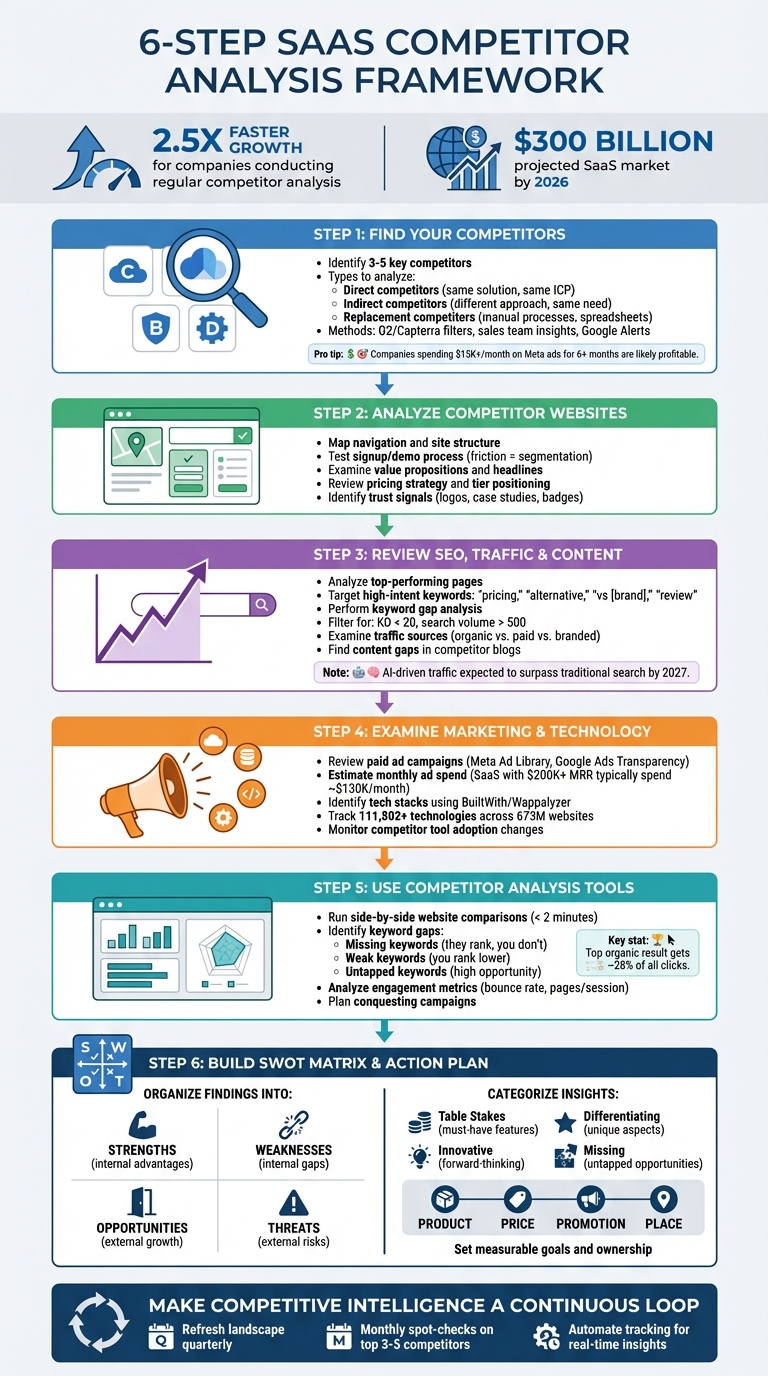
6-Step SaaS Competitor Analysis Framework
Competitor Analysis Framework: The 5 Step Guide You MUST Follow
Step 1: Find Your Competitors
Start by identifying who your competitors are. It's not just about the obvious ones - many SaaS companies miss indirect competitors and alternative solutions that often pull customers away. Begin with a broad search, then narrow it down to 3–5 key players for a focused analysis.
Direct vs. Indirect Competitors
To truly understand your competitive landscape, you need to look at all types of competitors: direct, indirect, and replacement options.
Direct competitors are those that solve the same problem for the same Ideal Customer Profile (ICP) using similar features. For example, Asana and Trello both target teams with project management needs, offering visual task organization. Indirect competitors, on the other hand, address the same customer need but through a different lens or product category. Think of Notion versus Slack - while one focuses on workspace tools and the other on messaging, both help teams stay organized and communicate.
Don't forget to include replacement competitors - these are the manual processes, spreadsheets, or custom-built tools that prospects currently use instead of your software. In many cases, your biggest competition isn’t another SaaS product; it’s the "do nothing" option, where customers stick with inefficient workflows. As Appcues aptly states:
"Product-market fit isn't found in a vacuum. It's forged in contrast".
When starting your analysis, it’s smart to focus on just 3–5 direct competitors to keep things manageable.
Now, let’s dive into how to identify these competitors using category filters and keyword analysis.
Use Category Filters and Industry Research
Start with SaaS review platforms like G2, Capterra, and Trustpilot. These sites allow you to filter by niche categories such as "CRM for Real Estate" or "Accounting Software for Freelancers". You can refine your search further by filtering for company size, industry, or geographic location, helping you validate and adjust your list of competitors.
Another valuable source of insights? Your sales team. Ask them which tools prospects mention during calls. Similarly, survey churned customers to find out which platforms they switched to - this can uncover indirect competitors you hadn’t considered. You can also set up free Google Alerts for niche-specific terms to keep track of which brands are consistently mentioned in blogs or industry news.
While industry research provides a solid foundation, keyword analysis offers a more data-driven way to identify competitors.
Find Competitors Through Keyword Overlap
Keyword overlap analysis shows you who’s competing for the same search traffic. Tools that generate "Organic Competitors" reports can reveal domains ranking for your target keywords. Focus on high-intent keywords that signal potential customer switching - search terms like "[Competitor Name] pricing", "alternative to [Tool]", or "[Category] review" are especially useful.
When filtering keyword gaps, prioritize terms with a Keyword Difficulty (KD) below 20 and a search volume above 500. Many B2B SaaS teams uncover 50+ high-intent keywords using this method.
Here’s another tactic you might not have tried: searching the Meta Ad Library for niche-specific keywords. Companies spending over $15,000 per month on Meta ads for at least six months are likely profitable and worth analyzing further. As Proven SaaS explains:
"The most reliable signal of competitor health is sustained ad spend. A SaaS running $15K/month in Meta ads for 6+ months is almost certainly profitable".
To make this process easier, tools like Competitor Analysis Tool can compare websites in under two minutes. They help identify demand gaps and visibility opportunities without requiring deep SEO knowledge, giving you actionable insights to prioritize which competitors deserve closer attention.
Step 2: Analyze Competitor Websites
Once you've pinpointed your main competitors, the next step is to dig into their websites. But don’t just focus on how the site looks - focus on how it works. As Seeto wisely points out:
"If you read a competitor's site as 'design', you see aesthetics. If you read it as 'data', you see strategy."
The goal? Understand their positioning, uncover their conversion strategies, and spot opportunities they’ve missed. Let’s break this down further.
Review Website Structure and Usability
Start by mapping out their navigation and subdirectories. This helps you understand how they prioritize content - whether it’s educational resources, product details, or customer support. Use audit tools to get a deeper sense of how they’ve invested in these areas.
Next, test their signup or demo process. Do they keep it simple with just an email, or do they ask for detailed information to filter for serious leads? As Seeto explains:
"Friction isn't an accident - it's segmentation strategy."
Even small delays, like a 100ms lag in page load time, can hurt conversions. These insights reveal how their structure supports their messaging and drives results.
Examine Value Propositions and Messaging
Once you’ve reviewed their site’s structure, dive into their messaging. Headlines offer a lot of clues about their strategy. Take a close look at how they present their value proposition on their homepage. Are they focused on direct outcomes like “Save 10 hours per week,” or do they lean into aspirational messaging like “Transform your workflow”? The first approach often prioritizes quick conversions, while the second suggests a broader branding play.
Pay attention to how their messaging evolves. For instance, a shift from calling themselves a "tool" to a "platform" might signal they’re moving upmarket or expanding their scope. Their ad copy - available through resources like the Meta Ad Library or Google Ads - can also provide valuable insights into their positioning. And don’t skip their comparison pages; these often highlight the differentiators they believe matter most.
Review Pricing Pages and Trust Signals
Take a close look at their pricing strategy. Transparent pricing often appeals to SMBs or self-serve customers, while “Contact Sales” pages usually target enterprise buyers. Check how they charge - by user, project, usage, or performance - and what that says about their target audience and revenue model.
Pay attention to the tier they label as “Most Popular.” This typically reflects their ideal customer profile and the average contract value they aim for. Also, note which features are exclusive to higher-priced tiers or offered as add-ons. These details can reveal their upsell strategy.
Trust signals are equally important. Look for customer logos, case studies, video testimonials, and badges from platforms like G2 or Capterra. For enterprise-focused competitors, features like SSO, audit trails, and security certifications can reassure high-stakes buyers.
Step 3: Review SEO, Traffic, and Content Strategies
Once you've examined a competitor's website structure and messaging, the next step is figuring out how they attract visitors. This is where you uncover which channels drive their traffic, which keywords they rely on, and how their content strategy aligns with their goals. As SEOsolved puts it:
"Your fastest path to predictable organic growth is hiding in plain sight: your competitors' data." – SEOsolved
Analyze Organic Keywords and Backlinks
Start by identifying the pages that bring in the most traffic. Instead of wading through endless keyword lists, tools like Ahrefs or Semrush can simplify the process with "Top Pages" reports. These reports highlight the URLs that are pulling in visitors [17, 19]. Pay close attention to high-intent keywords - terms like "pricing", "alternative", "vs [brand]", and "review." These keywords often indicate users are in the decision-making phase.
To go deeper, perform a keyword gap analysis between your site and your competitors. This will reveal high-ranking keywords you’re not targeting yet [17, 18]. Use filters to identify keywords that could offer quick wins. Don’t overlook the "Paid Keywords" report either - if a competitor is paying for a keyword they already rank for organically, it’s likely a highly valuable, conversion-friendly term. Additionally, tools like "Inspect" or "Ranking History" can help you spot if recent content updates have caused a traffic spike.
Once you’ve pinpointed the key keywords, evaluate how they perform across different traffic channels to understand their conversion potential.
Examine Traffic Sources and Metrics
Knowing where your competitor’s traffic comes from helps you understand their broader strategy. Look at the balance between organic and paid traffic, as well as the ratio of branded versus non-branded visits. This can give you a sense of their market position and brand recognition [16, 21].
Dive deeper by analyzing traffic quality metrics, such as average visit duration, pages per visit, and bounce rate. These metrics can shed light on how engaged their audience is and the overall user experience they provide. Another emerging trend to monitor is traffic driven by AI tools like ChatGPT, Claude, Perplexity, or Gemini. These assistants are increasingly influencing recommendations, and AI-driven traffic is expected to surpass traditional search traffic by 2027 [21, 22].
Review Content for Gaps and Opportunities
Take a close look at your competitors' blogs and resource sections to identify what topics they cover and where they fall short. Examine their main blog categories, tags, and content formats. This could include blog posts, webinars, videos, case studies, ebooks, and white papers [23, 26]. Long-form content - articles over 7,000 words - and visual elements tend to generate significantly more traffic and shares.
Look for broad topics that lack depth. Expanding these areas with subtopics, FAQs, or detailed guides can help you stand out. Also, consider how often your competitors update their content. If you notice they haven’t refreshed high-performing pieces in a while, this could be your chance to win over their audience with more current and relevant information [23, 10, 26].
Content gap tools can be particularly helpful here. Compare your site with three competitors, focusing on keywords with low difficulty (below 20) and decent search volume (above 500). Prioritize high-intent SaaS-related terms like "alternative", "pricing", and "vs [competitor]" that appeal to users actively comparing solutions.
As Moz wisely advises:
"The goal is to not simply recreate your competitor's content - that would have little chance of success - but to significantly improve upon it." – Moz
Step 4: Examine Marketing and Technology Strategies
Once you've analyzed traffic and content, it's time to dig into how your competitors attract customers and the technologies they rely on. These aspects give you a clearer picture of their investments and technical priorities, offering valuable insights into their overall strategy.
Review Paid Ad Campaigns and Social Media
Start by exploring tools like the Meta Ad Library and Google Ads Transparency Center to uncover your competitors' ad creatives, copy, and targeted regions. The presence of sustained campaigns often indicates profitability. Pay close attention to the messaging, calls-to-action, and emotional triggers they use to address customer pain points.
If you spot long-tail keywords in their paid search campaigns, it could mean they're targeting niche audiences with higher conversion potential. Platforms like Semrush or SpyFu can help you estimate their monthly ad spend. For example, SaaS companies generating $200,000+ in monthly recurring revenue typically allocate around $129,868 per month to advertising.
To gather even more insights, visit competitor websites to trigger retargeting ads and analyze the follow-up messaging. You can also append "/sitemap.xml" to their URLs to uncover landing pages specifically designed for ad campaigns. Additionally, scrolling through comments on their social media ads can provide a goldmine of information about common customer questions and concerns - potential areas you can address in your own campaigns.
Once you've mapped out their ad strategies, the next step is to look at the technologies that power these efforts.
Identify Technology Stacks
After analyzing ad campaigns, shift your focus to the tools and platforms your competitors use. This can help you understand their operational priorities and any technical limitations they might face. Tools like BuiltWith and Wappalyzer are great for identifying a competitor's CMS, hosting provider, analytics tools, payment systems, and ad tracking pixels.
For example, BuiltWith tracks over 111,802 internet technologies across 673 million websites, while Wappalyzer offers 50 free monthly lookups. Keep an eye out for ad tracking pixels, such as Meta or Google tags, to determine which platforms are driving their paid acquisition efforts.
"BuiltWith gives us the right amount of data mixed with intelligence to find prospects that matter. There's not a better tool to gain a competitive edge." – Thomas Holm Jensen, BuiltWith User
To stay ahead, set up website alerts to notify you when a competitor adopts new tools or switches platforms. These updates can signal strategic moves, like upgrading to a scalable infrastructure or introducing advanced marketing automation tools. Such shifts often reveal where they're focusing their growth efforts.
Step 5: Use Competitor Analysis Tool for Quick Insights
By now, you've gathered plenty of data from manual reviews of marketing strategies and tech stacks. But when you're ready to speed things up and turn insights into actionable recommendations, the Competitor Analysis Tool can be a game-changer. This tool simplifies the process by directly comparing your website to competitors, highlighting the most critical gaps - no advanced SEO knowledge required.
Run a Website Comparison
To get started, input your website's URL and a competitor's URL into the Competitor Analysis Tool. In less than two minutes, the tool provides a full analysis, breaking down traffic sources, keyword gaps, and messaging differences. It categorizes traffic into direct (brand-driven), organic (SEO), and paid (ad-based), giving you a clear picture of where visitors are coming from.
The tool identifies three key keyword gap types:
- Missing keywords: Competitors rank, but you don't.
- Weak keywords: You rank lower than your competitors.
- Untapped keywords: Competitors rank successfully, but you're absent.
This breakdown helps you pinpoint where competitors are capturing search intent, whether that's problem-aware or solution-aware queries. For instance, if a competitor dominates a keyword cluster that aligns with your target audience, you've just uncovered an opportunity to address unmet demand.
Beyond keywords, the tool evaluates engagement metrics like bounce rates and pages per session. These benchmarks reveal whether competitors are excelling in user experience or simply driving more traffic. Considering that the top organic search result garners about 28% of all clicks, identifying gaps in rankings can directly point to missed revenue opportunities.
Interpret Results and Prioritize Actions
Once the tool delivers its findings, focus on turning data into strategy. For example, sustained ad spend by a competitor - $15,000 or more per month for six months or longer - signals strong profitability and solid unit economics. This insight is critical, as SaaS companies conducting regular competitive analysis grow 2.5 times faster than those that don't.
To streamline your next steps, categorize the insights into four groups:
- Table Stakes: Features or strategies you must have to compete.
- Differentiating: Unique aspects that set you apart.
- Innovative: Forward-thinking capabilities worth exploring.
- Missing: Opportunities your competitors haven't addressed.
Pay close attention to traffic composition. A heavy reliance on paid traffic might indicate a competitor's dependence on capital, while a strong organic presence suggests a more sustainable SEO strategy. This is especially important as SaaS cost-per-click (CPC) rates have risen 15–18% year-over-year.
Use the tool's keyword gap analysis to plan conquesting campaigns. For example, in 2025–2026, TripMaster, a transit software company, generated $504,758 in Net New ARR by targeting users searching for competitor pricing and alternatives. They achieved this through dedicated comparison landing pages that intercepted high-intent traffic.
Lastly, focus on white space opportunities - areas where competitors are underperforming or not meeting market demand. These insights can directly inform your SWOT analysis and growth roadmap, helping you identify untapped avenues for expansion.
Step 6: Build a SWOT Matrix and Action Plan
Take the data you've gathered on traffic, keywords, pricing, and tech stacks, and organize it into a structured SWOT matrix. This tool helps you sort your findings into four categories: Strengths and Weaknesses (internal factors you control) and Opportunities and Threats (external market forces). By doing this, you can outline clear strategies for growth and improvement.
Create a SWOT Matrix
Your SWOT matrix should include both hard numbers (like traffic stats, keyword rankings, and pricing tiers) and softer insights (such as customer reviews and the tone of your messaging). Involve cross-functional teams to ensure you capture a broad range of perspectives. For instance, your product team might highlight a standout feature as a strength, while the sales team could point out challenges like high customer acquisition costs (CAC) as weaknesses.
Here’s an example of how to structure your SWOT findings:
| SWOT Component | Focus Area | Examples |
|---|---|---|
| Strengths | Internal Advantages | Proprietary AI algorithms, high customer lifetime value (LTV), agile development team |
| Weaknesses | Internal Gaps | High CAC, lack of enterprise-level features |
| Opportunities | External Growth | Competitor price hikes, untapped niche markets |
| Threats | External Risks | New, well-funded competitors; evolving data privacy laws |
To refine your analysis, cross-check your findings with customer feedback. For example, if a competitor boasts "enterprise-grade security" but customer reviews on platforms like G2 mention frequent downtime, that’s a threat you can turn into an opportunity by emphasizing your superior uptime. Look for market gaps, such as underserved customer segments or feature sets where competitors fall short. If most competitors cater to large enterprises, offering a simplified plan for small and medium-sized businesses could be a great way to stand out.
Keep your SWOT matrix up to date as market conditions evolve. A competitor’s pricing change or new feature launch could quickly turn opportunities into threats, so staying agile is key.
Prioritize Growth Opportunities
Once your SWOT matrix is complete, the next step is to turn insights into actionable strategies. Use the 4Ps framework - Product, Price, Promotion, and Place - to guide your actions. For example, if your Weaknesses highlight missing features like single sign-on (SSO) or audit trails, your product team should prioritize those updates. If your Opportunities show competitors ignoring emerging channels or niche partnerships, your marketing team can step in to capitalize on those gaps.
Break your action plan into three phases: immediate fixes, quarterly wins, and longer-term roadmap items. Start by addressing parity gaps - those must-have features your competitors already offer. For example, if every rival has Slack integration and you don’t, that’s a quick fix that needs immediate attention.
Here’s an example of how to map your SWOT insights to the 4Ps:
| SWOT Category | SaaS Growth Action (4Ps) | Example Initiative |
|---|---|---|
| Strengths | Promotion / Product | Highlight unique features in LinkedIn ads |
| Weaknesses | Product / Place | Add missing integrations; improve onboarding experience |
| Opportunities | Promotion / Price | Build comparison tools; introduce mid-market pricing tiers |
| Threats | Price / Product | Track competitor pricing; speed up development of defensive features |
Assign clear ownership and set measurable goals for each action. For instance, if you’re creating comparison landing pages to target competitor keywords, set a concrete objective like "increase demo requests by 25% within 90 days" and assign a responsible team member. Dive into competitor feedback to identify recurring complaints - these often highlight pain points you can address in your own product.
Finally, consider using a 2x2 positioning map (e.g., plotting "Ease of Use" versus "Power") to see where competitors cluster and identify underserved areas. This visual approach can help you pinpoint market gaps and streamline your strategy effectively.
Conclusion
Competitor analysis isn't something you do once and forget - it’s an ongoing process that sets fast-growing SaaS companies apart from those constantly playing catch-up. The six-step framework outlined here provides a repeatable method: pinpoint your competitors, evaluate their websites and pricing, dig into their SEO and content strategies, review their marketing tech stacks, use tools for quick insights, and build a SWOT-based action plan. Following this approach lets you trade guesswork for data-driven decisions, uncovering growth opportunities that others might overlook.
The stats speak for themselves. SaaS companies that regularly conduct competitive analysis grow 2.5 times faster than those that don’t. With the global SaaS market expected to reach nearly $300 billion by 2026, staying ahead demands staying informed. Market dynamics - like pricing adjustments, feature rollouts, or shifts in messaging - can change the game overnight.
Automate your competitive tracking. Relying on manual spreadsheets can leave you behind; by the time you notice a competitor's move, the opportunity may have passed. Automating your data collection, as discussed earlier, ensures your strategy stays current. Tools like Competitor Analysis Tool simplify this process, delivering actionable insights in under two minutes without requiring SEO expertise. These tools enable side-by-side website comparisons, help you spot demand and visibility gaps, and provide prioritized recommendations to focus on what truly drives results.
Make competitive intelligence a continuous loop. Regularly monitor pricing, new features, and ad campaigns. Set up automated alerts for updates and shifts so your insights remain fresh. Aim to refresh your competitive landscape quarterly while conducting monthly spot-checks on your top three to five direct competitors. This rhythm keeps your messaging relevant, supports smarter pricing experiments, and ensures your product roadmap addresses actual market needs.
Take action today. Run a quick analysis on your closest competitor to identify an actionable gap. Then, using the six-step framework, turn that gap into your next growth initiative. The sweet spot lies where your customers’ needs align with your competitors’ weaknesses and your product’s strengths - that’s where you win.
FAQs
How often should I run competitor analysis for my SaaS?
In the fast-moving SaaS world, staying ahead means keeping a close eye on your competitors. Experts recommend conducting competitor analysis at least every three months. However, if your market is particularly fast-changing or you're rolling out new features, you might need to do it more often.
Why the regular check-ins? They help you stay in sync with market trends and respond quickly to shifts in competitor strategies. It's all about keeping your edge in a constantly evolving landscape.
What’s the fastest way to find my real competitors (including indirect ones)?
To pinpoint your competitors - both direct and indirect - you first need to clarify what makes a company a competitor for your SaaS. From there, you can use several strategies to identify them:
- Keyword searches: Look for businesses ranking for the same terms your target audience searches for.
- Category scans: Explore your industry or niche categories to find similar products or services.
- Social media insights: Analyze platforms like LinkedIn or Twitter to see who's engaging with your audience.
- Review sites: Check platforms like G2 or Capterra to discover companies with similar offerings.
- Ad libraries: Tools like Meta's Ad Library can reveal competitors actively running ads in your space.
This structured approach helps you uncover competitors efficiently, including those you may not have initially considered.
Which competitor metrics matter most for my next growth decisions?
To stay ahead in the SaaS market, it’s crucial to focus on key competitor metrics. Pay close attention to pricing strategies, feature offerings, market positioning, and customer acquisition tactics. Diving deeper, examine metrics like revenue, ad spend, audience demographics, and ad creatives.
Why does this matter? These insights can help you spot opportunities to set your product apart, uncover gaps in the market, and fine-tune your pricing or feature set. By leveraging this data, you can make smarter decisions that drive growth and keep your product competitive.