
Competitor Research Checklist for SaaS Founders
Smart, focused competitor research—track 3–5 rivals, analyze pricing, ads, SEO, and customer feedback to spot gaps and sharpen your SaaS positioning.

Want your SaaS to stand out? It starts with smart competitor research. Here’s the deal: SaaS companies that regularly analyze competitors grow 2.5x faster. But most founders fall into the trap of reactive research, rushing to mimic features or pricing without a clear strategy. This checklist helps you avoid that by focusing on actionable insights.
Key Takeaways:
- Identify competitors smartly: Focus on 3–5 direct competitors and 1–2 indirect ones. Include replacement methods like spreadsheets.
- Spot pricing and ad spend trends: Sustained ad budgets ($10K+/month) often signal profitable growth.
- Leverage customer feedback: Use reviews and interviews to uncover gaps in competitors’ offerings.
- Analyze websites and SEO: Look at messaging, pricing structures, and keyword gaps for opportunities.
- Evaluate marketing channels: High direct traffic = strong brand loyalty; heavy paid traffic = capital-intensive growth.
Why It Matters:
With 68% of SaaS deals involving competition and acquisition costs rising, consistent competitor research can help you identify market gaps, refine your positioning, and avoid the "feature-matching trap." Ready to dive deeper? Let’s break it down.
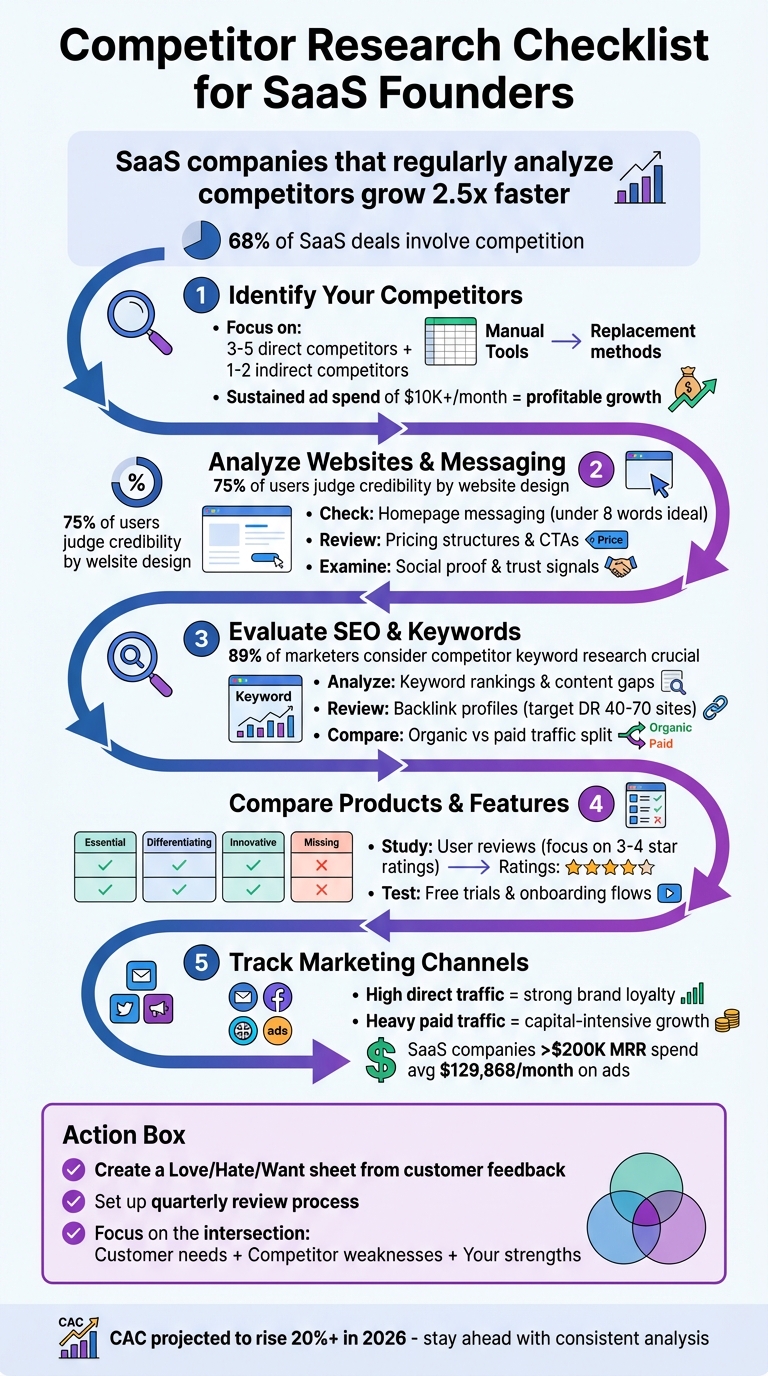
SaaS Competitor Research Framework: 5-Step Checklist for Founders
Mastering the art of B2B SaaS competitor research
Identify Your Competitors: Direct, Indirect, and Alternatives
When analyzing competitors, don't stop at the obvious ones - like companies bidding on the same keywords or appearing in comparison charts. B2B buyers now evaluate seven or more options before making a decision.
To make sense of the competition, group them into three categories: Direct competitors (offering the same solution for the same audience, like Asana vs. Monday.com), Indirect competitors (different solutions solving the same issue, like Notion being used instead of Google Docs), and Replacement methods (manual tools like spreadsheets or paper-based systems). Keep your focus narrow by selecting 3–5 direct competitors and 1–2 strong indirect competitors. This avoids getting overwhelmed while zeroing in on companies that could either win deals you're pursuing or lure away your existing customers.
Search for Competitors in Your Niche
Start by running Google searches with your primary keywords alongside modifiers like "best", "vs", "alternative", or "near me" to spot active competitors. Try typing "[Competitor Name] vs" into the search bar to see which comparisons people are searching for most often. Platforms like G2, Capterra, and Trustpilot are also goldmines for understanding which brands buyers are seriously considering.
For a deeper dive, check tools like the Meta Ad Library or Google Ads to see who's bidding on your category keywords. A sustained ad spend - especially $10,000+ per month over six months - is a strong signal that a competitor has figured out how to turn a profit. As Proven SaaS explains:
"The most reliable signal of competitor health is sustained ad spend. A SaaS running $15K/month in Meta ads for 6+ months is almost certainly profitable".
Tracking ad budgets can help you identify competitors that are thriving, giving you a clearer picture of the market landscape.
Use Customer Feedback to Find Competitors
Online research is essential, but customer feedback often uncovers competitors you might miss otherwise. Ask prospects questions like, "What are you using now?" or "What alternatives did you consider?" to identify rivals that aren't as visible online. Exit interviews and reviews provide even more insights, helping you build a "Love/Hate/Want" sheet to guide your strategy.
Platforms like G2 and Reddit are particularly useful for understanding why users switch tools. Common complaints like "too complex" or "pricing is confusing" highlight areas where competitors fall short. Use this feedback to create a simple "Love/Hate/Want" sheet:
- Love: Features users see as essential.
- Hate: Pain points that could be your opportunity to stand out.
- Want: Unfulfilled needs in the market.
This approach turns scattered feedback into actionable insights, helping you refine your strategy and stand out in a crowded field.
Analyze Competitor Websites and Messaging
A competitor's website isn't just about aesthetics - it's a roadmap to their strategy. In fact, 75% of users base a company's credibility on its website design. By analyzing these sites, you can uncover what resonates with their audience and apply those insights to sharpen your own approach.
Review Homepage Messaging and Calls-to-Action
Start with a five-second test: Can you quickly identify who the website is targeting, the problem it addresses, and the solution it offers? In 2026, homepage hero sections often feature headlines under 8 words (or 44 characters). Take note of whether their messaging leans toward "brand-led" (inspirational and abstract) or "conversion-led" (focused on measurable outcomes). Many SaaS companies today are shifting toward concrete, results-driven language to align with a more efficiency-focused market.
Pay attention to the sign-up process. Low-friction options, like email-only signups, streamline user activation, while more detailed forms (e.g., requesting company size or budget) often serve as tools for segmenting high-intent leads. As Seeto puts it:
"Friction isn't an accident - it's segmentation strategy".
Also, examine how competitors use social proof. Features like G2 badges, customer testimonials, and security certifications near calls-to-action can significantly boost conversions. For instance, TripMaster increased its Net New ARR by $504,758 in one year using competitor comparison landing pages and well-placed trust signals, achieving a 650% ROI and a 20% conversion rate from paid search.
Compare Pricing Structures and Packages
Once you've analyzed messaging, shift your focus to pricing. Competitor pricing pages reveal more than just costs - they highlight their value metric (what they charge for, like seats or usage) and their feature gating (which features are reserved for higher tiers). In 2025 alone, the top 500 SaaS and AI companies made over 1,800 pricing changes, with 80% revisiting their pricing strategies at least once a year.
To make meaningful comparisons, calculate the total cost of ownership for a common use case (e.g., 50 users over three years). This can help you uncover hidden fees, such as implementation costs or add-on charges. Look for trends in tiered pricing: if all competitors gate a specific feature at the same level, it likely sets a standard for the market. Public pricing often signals a focus on small-to-medium businesses, while "Contact Sales" buttons suggest an enterprise-oriented approach.
Finally, consider how pricing integrates with the overall user experience. Does the pricing page align with the rest of the site in terms of navigation and messaging? These details often reflect broader strategic goals.
Review Content and Navigation
A competitor's site structure and content strategy can reveal their priorities. For example, an extensive blog or resource section typically signals a focus on building long-term authority, while thin, product-centric posts may indicate reliance on paid traffic. Check if the navigation menu is streamlined, with 5 to 7 main items - this reduces cognitive load and improves usability.
Competitors' top-ranking pages can also provide insights into their content strategies. Since the #1 organic search result captures about 28% of all clicks, identifying these pages can help you understand which intent clusters they dominate. Tools like BuiltWith or Wappalyzer can further uncover their technical stack, revealing their CMS, analytics tools, and marketing automation platforms.
Lastly, assess their traffic sources. High direct traffic often reflects strong brand loyalty, while heavy reliance on paid traffic suggests a growth model dependent on capital. By piecing together these elements - messaging, pricing, content, and technical setup - you can form a clear picture of how competitors position themselves in the market and identify opportunities to stand out.
Evaluate SEO and Keyword Strategies
Competitor website analysis offers a wealth of information about how they attract and engage organic audiences. According to research, 89% of marketers consider competitor keyword research crucial for boosting online visibility. By analyzing the keywords your competitors rank for - and identifying the ones they’ve overlooked - you can pinpoint content opportunities that could drive growth for your site.
Analyze Keyword Rankings and Content Gaps
A great starting point is identifying keywords where your competitors rank, but you don’t. This type of keyword gap analysis highlights untapped traffic opportunities. Focus on "striking distance" keywords - terms where your site ranks within the top 20 but falls behind competitors. These are often easier to push into the top 10 with targeted optimization.
For example, a WordPress niche case study revealed 47 missing keywords. By targeting just 12 high-volume, low-difficulty terms, the site achieved page-one rankings for eight articles within 60 days.
But don’t stop with traditional SEO tools. Long-tail keywords can also be discovered by examining customer reviews on platforms like G2 and Trustpilot or by monitoring discussions in private Slack or Discord groups. These can reveal the specific language your audience uses when searching for solutions. As Keywordly.ai advises:
"Competitor keyword analysis works best when it's used to understand why pages rank - not just which keywords they rank for. The real opportunity lies in uncovering intent gaps, not copying keyword lists."
To make the most of your findings, categorize keywords by intent: Informational (answers questions), Commercial (comparisons/reviews), Navigational (finding a specific site), and Transactional (purchase-ready). This helps align your content with different stages of the sales funnel. You can also narrow your analysis to specific subfolders, such as /blog, to uncover top-of-funnel strategies your competitors are using.
Once you’ve mapped out keyword opportunities, it’s time to examine how competitors build authority through backlinks.
Review Backlink Profiles and Domain Authority
Analyzing competitors' backlinks provides insight into their authority-building strategies. Look at their total referring domains and metrics like Domain Rating (DR) or Domain Authority (DA) to assess the quality of their backlinks. Focus on dofollow links that come from relevant, high-quality content.
Using link intersect tools can help you identify "warm leads" - websites that link to several competitors but not to your site. These are ideal outreach targets since they’ve already shown interest in your niche. Prioritize sites with a DR of 40–70, as they offer meaningful ranking power without the challenges of pitching elite DR 90+ sites.
Another tactic is to analyze competitors’ most-linked pages. This reveals what types of content naturally attract backlinks in your niche. Additionally, broken link building can be effective: use SEO tools to find competitor pages with 404 errors that still have active backlinks, and then suggest your own live resource as a replacement.
As SaaSMonks explains:
"Your business competitors aren't always your SEO competitors. Sure, you may sell the same product, but in Google's eyes, the site outranking you for your primary keywords is your real competitor."
These backlink insights pave the way for understanding which pages generate the most traffic for your competitors.
Compare Organic Traffic and Top Pages
Knowing which pages drive the most traffic for competitors helps you identify successful content formats and topics. Look at their estimated monthly visits and the balance between paid and organic traffic. A site with predominantly organic traffic is likely investing heavily in SEO, while one relying on paid search may be vulnerable to rising ad costs.
Also, consider the split between branded and non-branded traffic. High branded traffic suggests strong name recognition, whereas high non-branded traffic indicates effective SEO for general industry terms. For instance, a case study of Hollywood Feed showed that 68.1% of its traffic came from branded keywords, highlighting strong brand loyalty but leaving room for competitors to target non-branded, high-intent searches.
Drill down into specific subfolders like /blog/ or /products/ to see which types of content are driving growth. Look for pages with high traffic but thin or outdated content - these are prime opportunities to create more comprehensive resources. Also, track whether competitors are capturing Featured Snippets or "People Also Ask" boxes for high-traffic queries. Adjusting your content structure with lists or tables can help you claim these spots.
Finally, consider Traffic Value - an estimate of how much the organic traffic would cost if purchased through paid ads. This metric can be a powerful way to demonstrate the ROI of SEO efforts when presenting findings to stakeholders. It provides a direct comparison between organic search investments and advertising costs, making it easier to justify your SEO strategy.
Compare Product Offerings and Marketing Strategies
Looking beyond how a website looks, digging into product features and marketing tactics can uncover valuable insights about your competition. Let’s break down how to assess what competitors offer and how they’re reaching their audience.
Compare Core Features and User Reviews
Start by categorizing competitor features into four groups: essential, differentiating, innovative, or missing. This method helps you figure out where you're competing on basic functionality versus where you can carve out a niche.
If possible, sign up for free trials to get a firsthand feel for their product. Pay attention to the onboarding process - it reveals a lot about their priorities. For example, if they highlight complex features right away, they likely see those as their strongest assets. On the flip side, a simple onboarding process (like only requiring an email) suggests they’re aiming for quick user activation. Meanwhile, longer forms with multiple fields often indicate a focus on segmenting leads for tailored follow-ups.
User reviews are another goldmine of information. Focus on 3- and 4-star ratings on platforms like G2 and Capterra for balanced feedback. These reviews often point out recurring frustrations, such as clunky interfaces, slow customer support, or pricing structures that penalize growing teams. These pain points can guide your strategy, showing you where you can step in and offer a better solution.
Analyze Marketing Channels and Traffic Sources
While product features show what competitors excel at internally, their marketing channels reveal how they attract and keep customers.
Look at their traffic sources to understand their acquisition strategy. High direct traffic signals strong brand loyalty, while heavy reliance on organic traffic points to solid SEO efforts. Competitors leaning on paid traffic may have cash-intensive models. For context, SaaS companies with over $200K in monthly recurring revenue reportedly spend an average of $129,868 monthly on ads.
A consistent ad spend of $10,000 or more per month for at least six months is a reliable indicator that their unit economics are working. Study their ad copy to identify messaging that resonates with their audience. Also, pay attention to the platforms they focus on - whether it’s social media, content marketing, or even comparison pages targeting searches like “Competitor Name alternatives”. These details can help you see where they’re investing heavily and where you might find opportunities to stand out.
Use Competitor Analysis Tool for Quick Insights
After exploring manual methods, it's time to simplify your research with automation. The Competitor Analysis Tool builds on your manual efforts, transforming them into automated, actionable insights. It takes the complexity out of competitor research and delivers concise, usable data.
Run a Free Analysis for Quick Results
The Free Analysis feature gets you started in less than two minutes. Just enter your website and a competitor's domain, and you'll quickly uncover demand and visibility gaps. The tool highlights keywords your competitor dominates and identifies areas where you can compete. Plus, this credit card–free scan helps you decide if a competitor is worth a deeper dive. For more detailed insights, you can upgrade to access advanced competitive signals.
Upgrade to Premium Analysis for Detailed Reports
If the free scan sparks your curiosity, the Premium Analysis takes things further. It offers detailed recommendations, competitive benchmarking, and real-time monitoring. Not only does it explain why your competitor's actions matter, but it also provides strategies to counter them.
For example, the tool tracks updates on pricing, features, and messaging in real time. You'll also get downloadable spreadsheets and a detailed breakdown of traffic composition, showing whether their strength lies in organic search, paid ads, or direct traffic. This kind of granular insight reveals where they're focusing their resources, helping you pinpoint areas where you can step in and gain an advantage.
Conclusion
With B2B SaaS customer acquisition costs projected to rise by over 20% in 2026, knowing where your competitors excel - and where they falter - can give you a decisive advantage.
Use this checklist to zero in on essential competitive insights. Then, transform those insights into action by fine-tuning your positioning, focusing on features that solve customer pain points, and crafting messaging that underscores what sets you apart.
As Nathan Gouttegatat from Proven SaaS explains:
"The goal of competitive analysis isn't just to see what everyone else is doing. It's to find the intersection of what your customers need, what your competitors do poorly, and what your product does exceptionally well. That intersection is where you win".
This mindset helps you avoid getting bogged down in endless analysis while staying agile. Concentrate on 3–5 key competitors and establish a quarterly review process to keep up with market changes.
Make these insights a core part of your strategy. Start with the free tools and manual techniques outlined here, and then scale your efforts with automation tools. Whether you're uncovering trends through customer feedback or using ad spend patterns to gauge competitor health, consistency is your greatest ally. Regular monitoring ensures you're ready to act on emerging opportunities.
FAQs
How often should I do competitor research for my SaaS?
Keeping tabs on your competitors isn’t a one-and-done task - it’s an ongoing process. For SaaS companies, a weekly review of competitor activities can make all the difference. Why? Because the SaaS market moves fast, and staying informed helps you spot shifts in the landscape before they catch you off guard.
By monitoring competitors regularly, you can:
- Identify emerging trends: Spot patterns or new strategies competitors are using that might impact your market.
- Adapt your approach quickly: React to changes, whether it’s pricing updates, feature launches, or marketing campaigns.
- Stay competitive: Understanding what others are doing ensures you’re not falling behind or missing opportunities.
Set aside time each week to review your competitors’ moves - it’s a small investment that can yield big insights.
What’s the fastest way to find my real competitors?
To quickly spot your true competitors, stick to straightforward, repeatable methods. Use tools like search engine strategies, category scans, social media analysis, review platforms, and ad libraries. Concentrate on the keywords and categories that matter to your business. This way, you can pinpoint both direct and indirect competitors in no time, streamlining the process without diving into lengthy manual research.
How do I turn competitor insights into a clear positioning angle?
To carve out a strong positioning angle, start by pinpointing gaps or unmet needs in what your competitors offer. Look at areas like feature shortcomings, pricing strategies, or customer feedback. Dive into reviews to spot common frustrations or overlooked demands. These insights can help you showcase how your product stands out, whether by addressing underserved segments or solving specific problems that others haven’t tackled. This approach ensures your offering connects with your audience in a meaningful way.