
What Is a Content Gap Analysis and Why It Matters
How SaaS teams identify missing or weak content, prioritize keyword opportunities, and create pages that improve SEO, AI visibility, and conversions.

Content gap analysis is the process of identifying missing or underperforming content on your website compared to competitors or audience needs. For SaaS companies, this means finding opportunities to create content that answers user questions, ranks higher on search engines, and drives conversions.
Why It’s Important:
- Missed Opportunities: If your site doesn’t answer key questions, users will go to competitors.
- SEO Performance: 75% of users don’t go past the first page of search results.
- AI Search Trends: With 60% of AI-driven searches ending without clicks, visibility in tools like ChatGPT is critical.
Key Benefits:
- Attract more qualified traffic.
- Improve search rankings by targeting high-value keywords.
- Address audience needs at every stage of the buyer’s journey.
By regularly performing content gap analysis, SaaS businesses can stay competitive, improve market positioning, and drive growth through better content strategies.
What Is Content Gap Analysis in SEO? (Explained in 2 Minutes!)
Why Content Gap Analysis Matters for SaaS Growth
For SaaS businesses, identifying and addressing content gaps is a key strategy for staying ahead of competitors and driving growth. A thorough content gap analysis helps you attract traffic, establish authority, and turn visitors into paying customers. By closing these gaps, you create a lasting advantage that compounds over time.
Improving Market Positioning
Pinpointing content gaps allows you to capture traffic from competitors by targeting what SEO experts often call "keyword goldmines." These are high-volume, high-conversion topics your competitors rank for, but you don’t. By crafting better, more detailed content on these topics, you can redirect potential customers from competitor websites to your own.
Search engines reward comprehensive content. For example, if your competitors offer detailed guides on API monitoring, troubleshooting, and integration tutorials, but you only have a basic product page, they’ll outrank you - even if your product is superior. Consider this case: in 2025, a B2B SaaS company partnered with SEOsolved to address gaps across 14 topics. They created 18 pieces of content (a mix of new articles, refreshed posts, and comparison pages) in just 10 weeks. The result? Within 90 days, 27 target keywords hit page one, and organic leads tripled.
Today, effective market positioning also means visibility in AI-driven platforms. As Ajdin Perco, Director of Content at Organic Growth Marketing, explains:
"We build an LLM matrix that contains prompts prioritized by features and solutions highly important to our clients. And we then analyze LLM visibility gaps for these prompts".
If your brand doesn’t show up in tools like ChatGPT or Perplexity when users search for your product category, you risk losing a growing segment of your audience.
Improving market positioning is just the first step. To retain traffic, your content must also meet your audience’s specific needs.
Aligning Content with Audience Needs
A content gap analysis highlights areas where your content fails to address critical questions or solve complete problems. Many SaaS companies focus heavily on top-of-funnel content, such as blog posts about industry trends or general advice, while neglecting the deeper resources prospects need during the consideration or decision stages. This includes comparison guides, case studies, and implementation tutorials.
When your site doesn’t provide the answers prospects are looking for, it creates "silent friction." Visitors may arrive searching for specific information - like how your product stacks up against a competitor or how to migrate from their current solution - and leave when they can’t find it. The impact is clear: the first search result captures a 39.8% click-through rate, while the third drops to just 10.2%. If you’re not answering these key questions, someone else will, and they’ll rank higher for it.
By aligning your content with what your audience needs at every stage of their journey, you set the stage for sustained growth.
Driving Long-Term Growth
Addressing content gaps delivers a snowball effect for growth. Take the example of a $15M ARR analytics SaaS company that partnered with RevvGrowth in October 2025. After months of stagnant traffic, they identified and filled content gaps where competitors were dominating. Within just four months, they tripled their organic leads.
This isn’t about simply producing more content - it’s about creating interconnected content clusters that keep users engaged and guide them through your sales funnel. Regular analysis also helps combat "content decay", where older posts lose rankings to newer competitor content. In the fast-paced tech world, running a quarterly gap analysis ensures your strategy keeps up with shifting search trends and competitor moves.
| Gap Type | Impact on SaaS Growth | Recommended Action |
|---|---|---|
| Topic Coverage | Establishes authority and expertise | Develop new pillar pages and supporting articles |
| Funnel Stage | Converts casual visitors into leads | Create comparison guides and case studies |
| AI Visibility | Keeps you relevant in AI-driven searches | Use structured data and concise, answer-focused content |
| Content Depth | Prevents losing rankings to competitors | Update thin content with expert insights and FAQs |
How to Perform a Content Gap Analysis: Step-by-Step
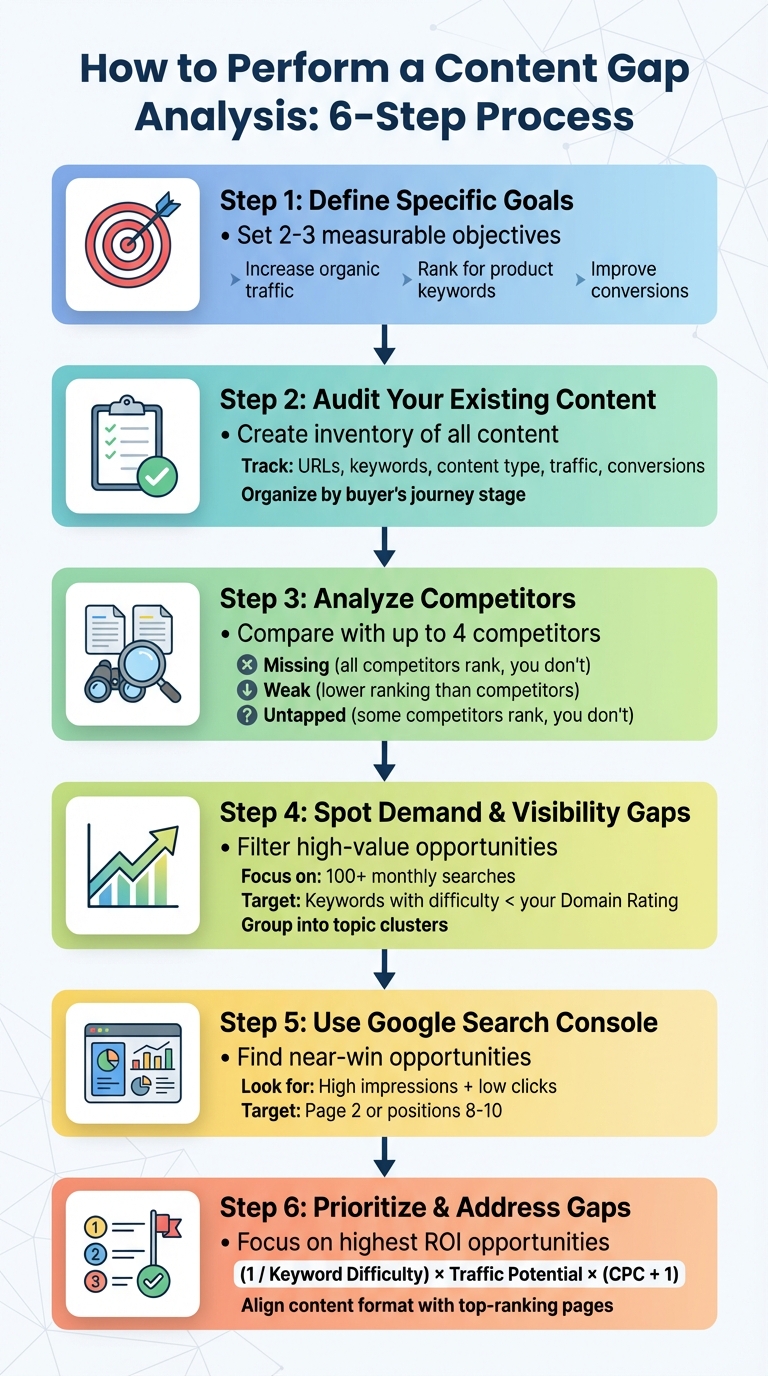
6-Step Content Gap Analysis Process for SaaS Companies
A content gap analysis involves six clear, data-focused steps. These steps guide you from setting goals to implementing content updates, helping your SaaS site stay competitive and relevant.
Step 1: Define Specific Goals for Your SaaS Business
Start by outlining your objectives. Are you looking to increase organic traffic in the next quarter? Do you want to rank for product-specific keywords to reach new audiences? Or is your focus on improving conversions with bottom-of-funnel content like comparison pages or implementation guides?
Your goals will direct the entire process. For instance, if you're introducing a new feature, prioritize gaps related to its use cases. If you're targeting a new market, focus on content that addresses unique challenges for that audience. Set 2–3 measurable goals - like ranking in the top 10 for integration-related keywords or covering every stage of the buyer’s journey with tailored content.
Step 2: Audit Your Existing Content
Create a detailed spreadsheet of your current content. Include each page's URL, focus keyword, content type (e.g., blog post, case study, product page), and performance metrics like organic traffic and conversion rates. This inventory helps you spot patterns and gaps you might otherwise overlook.
Organize your content by the buyer’s journey: awareness (top-of-funnel), consideration (middle-of-funnel), and decision-making (bottom-of-funnel). Many SaaS companies find they have plenty of awareness-level content but lack decision-stage resources like competitor comparisons or migration guides. Regular audits also reveal outdated content that needs refreshing to stay relevant.
Step 3: Analyze Competitors with a Competitor Analysis Tool
Identify what your competitors are doing better. Use a Competitor Analysis Tool to compare your site with up to four competitors. Focus on search competitors - those ranking for your target keywords - even if they’re not direct business rivals.
The tool categorizes keywords into three groups:
- Missing: Keywords all competitors rank for, but you don’t.
- Weak: Keywords where your ranking is lower than your competitors.
- Untapped: Keywords at least one competitor ranks for, but you’re missing.
Start by addressing "Missing" keywords for quick wins, then optimize "Weak" keywords to improve your current content. These insights are delivered in minutes, making it easy to prioritize your efforts.
Step 4: Spot Demand and Visibility Gaps
Filter your keyword data to find high-value opportunities. Focus on keywords with at least 100 monthly searches to avoid wasting time on low-demand terms. Also, target keywords with difficulty scores lower than your Domain Rating for easier wins.
As Vlad Orlov from Respona notes:
"Low difficulty means weaker competition, clearer search intent, and faster wins. As a rule of thumb, I avoid keywords with a difficulty score higher than my site's Domain Rating".
Group related keywords into clusters to prevent your content from competing with itself while building stronger topical authority.
After identifying high-demand gaps, validate the opportunities with performance data.
Step 5: Use Google Search Console for Performance Insights
Google Search Console can highlight where you’re close to success. Look for keywords with high impressions but low clicks - these are often on page 2 or in positions 8–10. Improving these pages with better headlines, expert commentary, or additional details can help push them into higher rankings.
Step 6: Prioritize and Address Gaps
It’s impossible to tackle every gap at once, so focus on those with the highest ROI. Use an opportunity score formula like:
(1 / Keyword Difficulty) × Traffic Potential × (CPC + 1).
This approach balances effort with potential traffic and revenue gains. Before creating new content, check the current search results. If the top-ranking pages are mostly product comparisons, a blog post might not perform well. Align your content format with what’s already ranking, then build a calendar prioritizing gaps that match your goals, difficulty levels, and buyer’s journey stages.
Tools for SaaS Content Gap Analysis
Specialized tools are the backbone of effective content gap analysis, especially in the fast-paced world of SaaS. They take what used to be a time-consuming, manual process and transform it into an efficient, streamlined workflow. For instance, modern platforms can generate detailed reports in less than three minutes, saving you hours - or even days - of effort. This kind of speed is critical in SaaS, where competitors and search trends evolve constantly.
One such tool, Competitor Analysis Tool, is specifically designed to help SaaS businesses uncover and address content gaps.
Competitor Analysis Tool Features and Benefits
The Competitor Analysis Tool equips SaaS companies with insights that are both quick and actionable. It completes a comprehensive analysis in under two minutes, comparing your website to competitors and pinpointing where you're falling behind. The results are presented in simple, nontechnical terms, breaking down opportunities into two key categories:
- Missing keywords: Terms all your competitors rank for, but you don't.
- Untapped keywords: Keywords where at least one competitor is gaining traction, but you're not.
The tool also prioritizes these opportunities based on their potential ROI. As Peter M. Buch, Head of SEO at Candycat Agency, puts it:
"Content gaps aren't just missing topics - they're conversations your audience is having without you".
By identifying these gaps, the Competitor Analysis Tool helps you join those conversations, ensuring your content aligns with your audience's needs and your business goals.
Comparison of Competitor Analysis Tool Plans
The platform offers two distinct plans to suit different needs:
| Feature | Free Analysis | Premium Analysis |
|---|---|---|
| Speed | Under 2 minutes | Under 2 minutes with priority processing |
| Keyword Discovery | Basic gap identification | Advanced intent mapping and topic clusters |
| Competitor Limit | Standard comparison | Multiple competitors with auto-detection |
| Insights Depth | Actionable recommendations | Prioritized by ROI and business impact |
| Report Access | Web-based viewing | Web-based + detailed exports |
| Credit Card Required | No | Varies by plan |
The Free Analysis plan is perfect for getting started - no credit card needed. It provides clear insights into your visibility gaps and highlights your first set of content opportunities. For businesses managing more complex strategies, the Premium Analysis plan offers advanced features like deeper competitive benchmarking and prioritization tools, making it ideal for larger teams or multi-market strategies.
Conclusion
As outlined earlier, making content gap analysis an ongoing process is essential in today’s ever-changing digital space. For SaaS companies navigating a fragmented search landscape, this approach offers a way to stay competitive. With search behaviors shifting, content must perform well not only on traditional search engines but also on emerging AI-driven platforms.
Consider this: a B2B SaaS company identified 120 missing or underperforming keywords within 90 days. By updating and publishing 18 pieces of content, they managed to triple their organic leads and rank 27 target terms on page one. This kind of success comes from pinpointing where competitors excel and addressing unanswered questions from their audience.
The Competitor Analysis Tool simplifies this process by revealing the keywords and topics your competitors are leveraging. It enables quick, actionable insights, allowing you to align your strategy with current market demands. By using this tool regularly, you can turn these insights into strategies that keep your content relevant and competitive.
The best SaaS companies treat content gap analysis as a quarterly priority, not an occasional task. With search intent evolving, competitors adapting, and AI platforms rising, frequent audits ensure you’re not just keeping up - you’re staying ahead. Start your analysis today, focus on achieving quick wins, and establish the topical authority that signals to both search engines and AI systems that your brand is a leader in its field.
FAQs
How often should a SaaS company run a content gap analysis?
A SaaS company should make it a habit to perform a content gap analysis on a regular basis. Experts often suggest doing this either every quarter or twice a year. Why? Regular reviews ensure you're keeping up with shifting market trends and staying ahead of competitor strategies. Plus, they help uncover areas where your content might be falling short, giving you the chance to fine-tune your efforts and better address the needs of your audience.
Which pages should I fix first: missing topics or underperforming ones?
When refining your content strategy, start by addressing missing topics. These gaps represent opportunities to attract new audiences and expand your reach. By creating content around these overlooked areas, you can tap into untapped search queries and interests, bringing in fresh traffic.
Once you’ve filled those gaps, shift your focus to underperforming pages. These pages might not be meeting their potential, but with some targeted optimization, you can improve their performance. Align these pages with your overall strategy by refining the keywords, updating outdated information, or improving the user experience. This two-step approach ensures you're both expanding your audience and maximizing the value of your existing content.
How do I measure if closing a content gap increased revenue?
To determine whether closing a content gap has boosted revenue, focus on tracking organic traffic, search rankings, and conversions both before and after making updates. Tools like Google Search Console or your site’s analytics platform can help you monitor changes in visibility, user engagement, and conversion rates. By comparing these metrics over time, you can connect improved content performance - especially for targeted keywords or pages - to potential revenue growth.