
10 Ways to Improve Your Market Positioning in 2026
Practical strategies to sharpen SaaS market positioning in 2026: niche focus, AI visibility, pricing, trust, partnerships, product-led sales, and lifecycle alignment.

Market positioning in 2026 is all about standing out in a crowded SaaS landscape where over 30,000 companies compete for attention. With AI tools driving buyer research and customer acquisition costs soaring, your brand's success hinges on clear, strategic positioning. Here's what you need to know:
- Niche Focus Wins: Specialize in specific verticals or use cases to differentiate.
- AI Visibility is Critical: 81% of B2B buyers rely on AI assistants like ChatGPT to shortlist vendors.
- Educational Content Builds Authority: Buyers prefer vendors who help them understand their problems.
- Trust Drives Sales: 81% of buyers prioritize trust over price.
- Strong Partnerships Matter: Integrated ecosystems make your product harder to replace.
- Product-Led Sales (PLS): Let users experience value before engaging sales.
- Thought Leadership: Establish your brand as an industry expert with original insights.
- Updated Personas: Refresh your Ideal Customer Profile (ICP) and buyer personas regularly.
- Lifecycle Positioning: Align strategies across awareness, evaluation, and retention stages.
- Competitive Intelligence: Monitor competitors to identify gaps and opportunities.
The key to thriving in 2026 is understanding your customers deeply, crafting precise messaging, and leveraging tools like AI and partnerships to stay ahead.
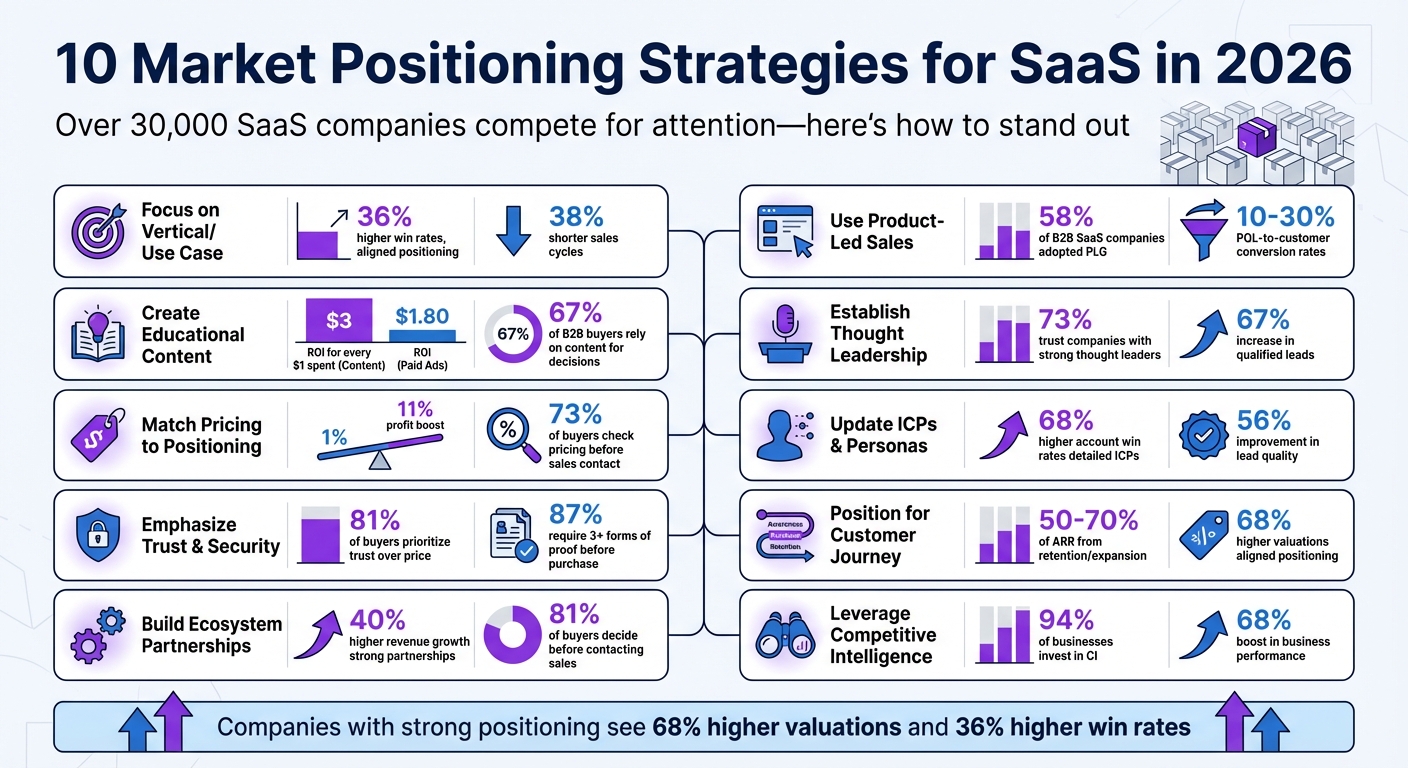
10 Market Positioning Strategies for SaaS Success in 2026
1. Focus on a Specific Vertical or Use Case
Relevance to SaaS Market Trends in 2026
Trying to serve everyone ultimately weakens a SaaS company's impact. With AI tools like Claude Code and Cursor making it easier to replicate features, horizontal SaaS companies are increasingly pressured by both venture-backed giants and agile AI-first startups. The companies thriving in 2026 are those that dominate a specific vertical or use case, rather than attempting to appeal broadly.
By narrowing your focus, you're no longer competing on features alone - you’re competing on how well you solve specific problems. Take Monday.com as an example. Instead of entering the crowded project management space as just another task manager, they positioned themselves as a "Work OS" tailored to team workflows. This strategic focus allowed them to stand out and drive revenue growth. Similarly, between 2021 and 2024, Miro honed in on use cases like "remote meetings" and "agile workflows", which helped them grow from 1 million to over 35 million users and achieve a valuation of over $17.5 billion.
These trends prove the value of a focused strategy, which starts with understanding your customers deeply.
Implementation Steps
Start by conducting 15–20 discovery conversations within a single vertical. Pay close attention to the language your customers use when describing their challenges - this will shape your positioning. For example, David Cancel, founder of Drift, conducted over 100 customer interviews. He discovered that practitioners didn’t just want "improved lead generation"; they wanted to "connect with website visitors before they leave." This insight led to messaging that helped Drift grow from zero to $10 million ARR in under 18 months.
Use these insights to craft a clear value proposition. A helpful framework is:
For [specific customer], who [experiences a specific problem], our [solution] delivers [primary benefit]; unlike [alternative], we uniquely [differentiation].
Next, identify 3–5 key factors that matter most in your chosen vertical - such as compliance requirements or speed of implementation - and focus on excelling in those areas.
How to Create a Competitive Advantage
Focusing on a vertical creates what’s often called "narrative gravity", meaning your messaging naturally attracts the right prospects while discouraging mismatched ones. Companies with well-aligned positioning see 36% higher win rates and 38% shorter sales cycles.
A great example is Gong, which shifted its positioning in 2021 from sales training software to a "revenue intelligence platform." By focusing on the outcome of "revenue intelligence", rather than just the training process, Gong achieved 2.5× annual revenue growth between 2019 and 2021, reaching a $7.25 billion valuation.
When customers see how your product directly addresses their specific needs, price becomes less of a barrier. In fact, B2B buyers are 3.1× more likely to make larger purchases from vendors who uncover hidden needs in their vertical. Additionally, 74% of B2B buyers prefer vendors who help them identify and define their problems, not just respond to existing requirements.
By aligning your messaging with these precise customer needs, you can strengthen your competitive edge even further.
Alignment with Customer-Focused Strategies
To truly reinforce your vertical strategy, shift your perspective. Instead of thinking, "we built X to solve Y", reframe it as, "for customers struggling with Z, we deliver A". This mindset helps uncover gaps in workflows that generalist tools often overlook. For example, a 2025 Shopify survey highlighted distinct priorities across verticals, such as brand reputation for Food & Beverage and product quality for Home & Garden.
Finally, map out the "decision ecosystem" within your target vertical. B2B purchases typically involve 6–10 stakeholders. Understanding how decisions are made in your industry lets you address the concerns of each stakeholder effectively, avoiding one-size-fits-all messaging. This tailored approach can make all the difference in winning over complex buying teams.
2. Create Educational Content to Build Authority
Relevance to SaaS Market Trends in 2026
Educational content has become a cornerstone of growth strategies, especially as paid customer acquisition costs are now 5–10 times higher than organic methods. A striking 67% of B2B buyers rely on content to educate themselves during their decision-making process, seeking a self-guided journey without the need for sales representatives. To stay ahead, content must be tailored for both Answer Engine Optimization (AEO) and Generative Engine Optimization (GEO). This means structuring your material so that AI tools like ChatGPT, Perplexity, and Google's Search Generative Experience can easily reference it. Prioritize original data and "answer-first" formats to meet the needs of these AI-driven platforms.
"Your competitors can copy your features, but they can't replicate three years of published content ranking on page one".
Implementation Steps
Start by diving into your existing customer interactions. Look at sales demos, support tickets, and feedback to uncover pressing customer challenges - these can spark ideas for impactful content. When creating each piece, use question-based headings like "How do I reduce churn in Q1?" and follow them with clear, direct answers in the opening paragraph. This format helps AI systems extract and cite your content effectively.
Instead of standalone articles, focus on building interconnected topic clusters. Create in-depth "pillar" pages on broad subjects and link them to more specific cluster articles targeting long-tail keywords. To further improve visibility, implement JSON-LD schema markup (such as Article, FAQ, or Organization schemas) to enable rich snippets. Also, ensure your site achieves a First Contentful Paint in under 2 seconds for a smoother user experience. These steps position your brand to outpace competitors in search rankings and AI-driven citations.
How to Create a Competitive Advantage
Investing in educational content pays off - generating $3 for every $1 spent, compared to $1.80 for paid ads. By positioning your brand as a trusted advisor, you can stand out. Research shows that 74% of B2B buyers prefer vendors who help them understand their problems and uncover unconsidered needs. These buyers are also 3.1 times more likely to make larger purchases in such scenarios. Use tools to analyze competitor websites and identify gaps in your competitors' strategies, such as niche use cases or overlooked security concerns. Addressing these gaps with targeted educational content allows you to connect with audiences that might otherwise be out of reach. Extend this approach across the entire customer lifecycle to further solidify your market position.
Alignment with Customer-Focused Strategies
Educational content isn't just for attracting new customers - it should support every stage of the customer journey. Map your content to the full lifecycle, from acquisition to retention. By 2026, 50–70% of ARR growth is expected to come from retention, expansion, and referrals rather than new customer sign-ups. This means creating resources like onboarding tutorials and feature walkthroughs for existing customers, alongside top-of-funnel content for prospects.
Repurpose your in-depth guides into bite-sized formats like LinkedIn carousels, Twitter threads, short videos, and email newsletters to expand your reach. Additionally, founder-led content on platforms like LinkedIn can organically drive 70–80% of early-stage pipelines. Sharing authentic lessons, actionable frameworks, and honest takes on industry trends helps build trust and positions you as a thought leader. Over time, these educational assets will continue to nurture prospects and reinforce your authority in the market.
3. Match Your Positioning with Your Pricing
Relevance to SaaS Market Trends in 2026
Once you've nailed your positioning strategy, your pricing has to back it up. Pricing isn't just about numbers; it tells your audience where you stand in the market. By 2026, SaaS buyers will continue gravitating toward two extremes: premium solutions or budget-friendly options. The middle ground is shrinking fast, leaving little room for companies that try to appeal to everyone. With 73% of SaaS buyers checking pricing before even talking to sales, your price point sends an immediate message - are you a high-end solution or a cost-effective alternative?
Here's why pricing matters so much: tweaking your pricing strategy by just 1% can drive an 11% boost in profits. Despite this, nearly 80% of SaaS companies adjust their pricing annually to stay competitive, but only 24% use specialized pricing tools. Those that do see returns up to 2.5x higher. Getting your pricing right isn’t just a detail - it’s a game-changer.
Implementation Steps
Start by calculating your three-year Total Cost of Ownership (TCO). This includes everything - implementation fees, add-ons, and any usage overages. Once you have that, tie your pricing to a value metric that grows as customers gain more from your product. For example, instead of charging per seat, think about pricing based on active users, resolutions handled, or data processed. This kind of approach can bring in 15–35% more revenue compared to traditional cost-plus pricing models.
"Your price reflects the true exchange rate of the value you deliver." - Patrick Campbell, Founder of ProfitWell
To ensure your pricing aligns with your goals, use the 5 C's Framework: Company objectives, Customers, Costs, Competition, and Channel members. If your product offers real differentiation, resist the urge to match competitor prices - it’s a fast track to commoditization. When adjusting prices, consider grandfathering existing customers at their current rates for 6–12 months. This approach can help retain up to 13% more users during the transition.
How to Create a Competitive Advantage
Your pricing strategy should clearly reflect your positioning. You have three main options: price lower to break into established markets, match competitors when focusing on user experience, or price higher for enterprise-level solutions that offer clear differentiation. For example, a premium product might be priced at $29 per unit compared to a basic option at $15, signaling its higher value. This clarity can help you avoid the profit-draining effects of reactive price wars.
Use tools like a Competitor Analysis Tool to identify pricing gaps. Look for opportunities where competitors are either undercharging for valuable features or overcharging for basic ones. By optimizing your pricing based on these insights, you can increase your Annual Run Rate (ARR) by an average of 25% - without needing to acquire new customers. Companies that actively manage their pricing strategies see operating margins 10–15% higher than those that don’t.
Alignment with Customer-Focused Strategies
Your pricing model should work across the entire customer journey, not just at the point of sale. Hybrid pricing models - combining a base subscription with usage-based charges - are already used by 77% of SaaS companies. These models strike a balance between predictable revenue and fair value capture as customers scale. You can also use psychological anchoring by showcasing your highest-priced tier first. This tactic can increase the selection of your target mid-tier plan by up to 25%.
Transparency is key. Clearly communicate your pricing and quantify the outcomes for your customers. For instance, if your product saves them 5 hours per week at an $80 hourly rate, that translates to $20,800 in annual savings. Framing your value this way helps buyers justify higher pricing and positions you as a partner in their success.
4. Emphasize Trust and Security in Your Messaging
Relevance to SaaS Market Trends in 2026
In the evolving SaaS landscape, trust has become the cornerstone of successful marketing. By 2026, 81% of B2B buyers will prioritize trust over price and ROI when choosing vendors. Adding to this, buyers now spend less than 20% of their decision-making process engaging with vendors directly. With the surge of AI-generated content, skepticism toward generic corporate messaging - often dismissed as "AI slop" - has grown. This makes it critical for companies to go beyond surface-level claims and use trust-building tools like security certifications and ethical data practices to gain an edge. These elements are no longer just compliance measures; they’re now key to speeding up sales cycles.
"Trust shortens sales cycles. Lack of it kills deals instantly."
– Chad de Lisle, Disruptive Advertising
The numbers back this up: 87% of B2B buyers require at least three forms of proof, such as technical demos, case studies, and third-party validation, before committing to a purchase. This shift has led companies to adopt proof-based marketing, focusing on transparency and measurable results to address the growing demand for evidence.
Implementation Steps
To counter the impersonal feel of AI-heavy marketing, start by spotlighting your team. Share video interviews or blog posts featuring engineers, product managers, or founders. This human-centered approach helps establish credibility more effectively than polished, overly produced content. For instance, in 2025, Nomadic Soft's CEO Gregory Shein introduced interactive case studies showing real client metrics, boosting demo sign-ups by 22%.
Security certifications should also take center stage. Prominently display compliance badges such as PCI-DSS Level 1, GDPR, and SOC2 in user-facing platforms. Additionally, un-gate technical documentation and pricing information to make it easier for AI tools to surface your product during buyers’ research phases. Interactive case studies and free-text demo fields are also effective ways to emphasize trust and collect actionable insights.
How to Create a Competitive Advantage
To further differentiate your brand, leverage third-party validation. Buyers trust independent endorsements more than self-promotional claims. Invest in digital PR and expert commentary to position your company as a leader in your niche. Transparency also plays a big role - don’t just show polished results; reveal your internal processes and decision-making frameworks. This approach builds credibility quickly.
"Pulling back the curtain on your process builds trust faster than any vague guarantee. Show the messy middle, not just the polished outcome, and watch your credibility soar."
– Siddharth Vij, Co-founder & Design Lead, Bricx Labs
Take Okta as an example. By shifting its focus from "identity management" to "zero trust security" during the remote work boom, the company aligned itself with pressing market needs. This strategic move helped grow its revenue from $41 million to over $1.3 billion in just seven years. Similarly, addressing unconsidered needs can drive larger purchases, with buyers being 3.1x more likely to invest more when vendors help them uncover these needs.
Alignment with Customer-Focused Strategies
Trust messaging shouldn’t end at the sales pitch - it should flow through the entire customer journey. Align your brand’s positioning with high-intent SEO strategies and problem-aware content to ensure prospects already understand your value when they reach you. Use specific, actionable metrics in your messaging - like "Automate 83% of manual data entry" - to drive clarity and improve conversion rates by 41%.
Finally, document and communicate how your product transforms your customers’ businesses. Companies with strong positioning and consistent trust messaging see 68% higher valuations, and 74% of B2B buyers prefer vendors who help them envision their problem before offering solutions. By framing challenges clearly and presenting your product as the answer, you create a trust-driven narrative that sets you apart in the competitive SaaS market of 2026.
5. Position Through Ecosystem and Partnerships
Relevance to SaaS Market Trends in 2026
In today's SaaS landscape, simply outspending competitors on ads and SEO isn't enough to drive lasting growth. By 2026, the real edge lies in building strong networks of strategic partnerships. Research shows that companies with robust partnership ecosystems see 40% higher revenue growth compared to those relying solely on internal efforts.
Here's why this matters: AI agents now guide software discovery through "invocation" rather than traditional search. If your product isn’t integrated into key ecosystems, tools like ChatGPT won’t recommend it to potential buyers - even if your solution is excellent. This makes a well-thought-out partnership strategy essential for staying competitive.
Implementation Steps
The first step is to define a Partnership Ideal Profile (PIP). Look for partners that align with your market, complement your technical capabilities, and share similar values. Instead of chasing sheer numbers, focus on a few high-value partnerships; five or six strong alliances can outperform hundreds of low-engagement connections.
Next, explore opportunities where your product can collaborate with both Independent Software Vendors (ISVs) and Systems Integrators (SIs). These three-way partnerships are especially effective in solving industry-specific challenges, leading to stickier and more valuable enterprise deals. Once you’ve found the right partners, create a Mutual Value Proposition that clearly outlines the shared goals, the problem being addressed, and the expected return on investment.
To reduce friction, automate the administrative side of partnerships. Use CRM-native tools to track partner-driven revenue and streamline deal registrations in real time. Avoid requiring partners to log into separate portals - integrate tools like Slack or email links to keep the process smooth and efficient.
How to Create a Competitive Advantage
Once your partnership framework is in place, leverage technical integrations and network effects to strengthen your position. Ecosystems naturally raise switching costs. When customers integrate your product deeply with multiple partner solutions, replacing it becomes a major disruption to their workflows. For example, Shopify’s app ecosystem, with over 8,000 apps, accounted for 32% of new merchant growth and generated over $1 billion in partner revenue. Similarly, Salesforce’s AppExchange drove $12.4 billion in partner revenue in FY2025 - a 20% year-over-year increase.
"In a market where software is easy to build and hard to differentiate, ecosystems become the real competitive advantage. They turn products from isolated tools into networked infrastructure."
– Prayerson
To make these integrations seamless and hard to replace, design stable APIs and standardized data formats. This not only strengthens your ecosystem but also ensures that AI tools recommend your product during the research phase. This is critical when 81% of B2B buyers make their vendor decision before ever speaking to a sales rep.
Alignment with Customer-Focused Strategies
Your partnership strategy should align with the needs of today’s complex buying processes. Customers are no longer looking for isolated tools - they want bundled solutions that work together seamlessly. Map the decision-making ecosystem, which often involves 6–10 stakeholders in B2B purchases, and ensure your partnerships address their specific workflow needs.
Look for opportunities where competitors fall short, such as in niche vertical integrations, and use strategic partnerships to fill those gaps. For example, creating vertical triads with an ISV and an SI can help address industry-specific challenges like healthcare compliance or financial services automation. By doing so, you transform your product from a standalone tool into an indispensable part of a larger workflow.
Finally, equip your partners with "Always-On" resources like self-service portals and on-demand knowledge bases. This ensures they can engage and implement solutions without needing constant support from your team.
6. Use Product-Led Sales in Your Positioning
Relevance to SaaS Market Trends in 2026
With pricing strategies and trust-building already in place, product-led sales (PLS) takes things a step further by letting buyers experience the product's value firsthand. The old-school "demo-first" sales model is quickly losing ground. By 2026, 58% of B2B SaaS companies will have adopted product-led growth, and 91% plan to increase their investment in this approach. Buyers now prefer to explore products on their own terms before deciding if they need additional help.
PLS addresses this preference by focusing sales efforts on users who are already engaging with the product and showing interest in upgrading. This approach not only prioritizes customer needs but also streamlines sales processes.
"It's not that buyers don't want to talk to sales. They just don't want to talk to sales first." – Adam Boyle, VP of Product at Tackle
To make this work, companies need clear systems in place to identify and nurture engaged users.
Implementation Steps
Start by defining Product Qualified Leads (PQLs) based on specific usage behaviors. For example, signals like hitting usage milestones, inviting team members, or frequently testing premium features can indicate readiness to upgrade. A great example is Slack, which considers a team a PQL after they’ve sent 2,000 messages, a point that predicts a 93% likelihood of converting to a paid plan.
Next, integrate product analytics into your CRM to give sales teams a clear view of user activity and intent.
Finally, establish clear criteria for when an account transitions from self-serve to sales-assisted. For instance, Snyk tracks users who identify and fix a vulnerability within their first 30 days - a milestone that strongly correlates with long-term retention.
How to Create a Competitive Advantage
In 2026, competitive success isn’t just about having better features - it’s about timing. Delays in delivering value can cost conversions. For instance, every 10-minute delay in time-to-value (TTV) can lead to an 8% drop in conversion rates.
PLS helps you act at the right moment by identifying when users hit their "aha moment." Sales teams can then step in to guide them toward expansion. This strategy delivers results, with PQL-to-customer conversion rates ranging from 10% to 30%, while also reducing the number of trial users who abandon the product due to a lack of timely engagement.
Alignment with Customer-Focused Strategies
PLS aligns perfectly with how modern buyers prefer to shop. Today’s B2B buyers spend less than 20% of their journey talking to vendors, and 73% prefer online purchasing over traditional sales-heavy methods. By emphasizing product-led sales, you’re adapting to these preferences and positioning your company as a buyer-friendly alternative.
To support decision-making in complex B2B purchases - where the average buying group includes 13 stakeholders - offer a "decision package." This could include a one-page summary of outcomes, security details, an ROI model, and social proof. Such resources empower users to advocate for your product internally, reducing the need for constant sales interaction and reinforcing your reputation as a forward-thinking, customer-centric business in a market still clinging to outdated sales methods.
7. Build Thought Leadership in Your Industry
Relevance to SaaS Market Trends in 2026
Incorporating strategies like product-led sales and forming strategic partnerships is important, but establishing thought leadership takes your market position to another level. By 2026, B2B marketing has shifted focus - from chasing visibility to building authority. Consider this: 73% of B2B buyers trust companies with strong thought leaders more than those without, and 81% select their vendor before even engaging with sales. This underscores the importance of having your ideas work for you before a prospect even considers a demo.
With 64% of people distrusting major media sources, audiences are increasingly looking to individual experts for reliable insights. When your brand becomes the go-to source others cite, you rise above the noise. As Spinta Digital aptly states:
"In 2026, your brand's greatest differentiator won't be your product or price - it'll be the power of your ideas."
This shift means your ideas need to lead the conversation, setting you apart long before any sales pitch.
Implementation Steps
Start by narrowing your focus. Instead of covering broad SaaS marketing topics, zero in on a specialty - like AI integration in enterprise sales. The more specific your niche, the faster you can establish credibility. Develop a contrarian viewpoint to stand out, such as: "While most believe X, our insight Y shows Z."
Anchor your strategy with a flagship research report - something comprehensive, like a 4,000+ word analysis. For example, in February 2026, a cybersecurity firm launched its "Cyber Clarity" series, with the CEO and CMO co-authoring monthly, research-driven pieces. Within nine months, this initiative led to a 68% increase in Share of Voice, a 210% rise in media citations, and a 42% boost in pipeline attribution from their thought leadership.
To ensure your content gets noticed, optimize for Answer Engine Optimization (AEO). Use question-based headers and provide concise, evidence-backed answers. This makes it easier for AI tools like ChatGPT and Perplexity to reference your work. Additionally, leverage your proprietary data to conduct original research - creating content that competitors can't easily replicate.
How to Create a Competitive Advantage
Investing in thought leadership pays off. Companies that focus on it see a 67% increase in qualified leads, with those leads achieving a 34% higher close rate compared to businesses relying solely on promotional content. Take ProfitWell as an example. Patrick Campbell built their authority by publishing a weekly "Pricing Strategy" series for over two years, analyzing data from thousands of companies. This approach positioned ProfitWell as the go-to authority on pricing and contributed to their $200 million acquisition.
In 2026, your competitive edge isn’t just about your product features - they can be imitated. Instead, it lies in the intellectual capital you build through consistent, data-driven thought leadership. This creates a strong market position that competitors can't replicate overnight.
Alignment with Customer-Focused Strategies
Educational content doesn’t just build authority - it helps engage buyers early in their decision-making process. 74% of B2B buyers prefer vendors who help them understand their problems better, and they’re 3.1x more likely to make larger purchases from vendors who identify needs they hadn’t considered. Instead of pushing solutions, your content should guide buyers in shaping their vision of the problem.
Use the T.H.I.N.K. Framework to craft compelling content:
- Teaches: Share actionable knowledge.
- Humanizes: Make your expertise relatable.
- Inspires: Lead with a strong vision.
- Narrates: Shape the story of your category.
- Keeps it relevant: Tie insights to market realities.
This approach positions your brand as a trusted advisor, not just another vendor.
8. Update Your Ideal Customer Profile and Buyer Personas
Relevance to SaaS Market Trends in 2026
By 2026, 81% of B2B buyers will have shortlisted or ruled out vendors before ever making contact. This means if your Ideal Customer Profile (ICP) and buyer personas are outdated, you could be missing out on critical early-stage visibility. In a market where AI can replicate features with ease, your understanding of customers - and the trust you build with them - becomes your most enduring edge.
Modern ICPs need to go beyond basic demographics. To stay competitive, you’ll need to factor in technographics (like the tools and platforms your prospects use) and buying triggers such as recent funding, executive changes, or rapid hiring sprees. The payoff? Companies with detailed ICPs see 68% higher account win rates and 36% better customer retention. Plus, sales teams aligned with these profiles report 38% higher success rates.
Implementation Steps
Refining your ICP and buyer personas is key to sharpening your messaging. Start by distinguishing between the two:
- ICP: Defines the ideal company based on factors like industry, revenue, growth stage, and tech stack.
- Buyer Personas: Focuses on specific roles within those companies, such as Economic Buyer, Technical Buyer, User Buyer, and Champion.
Most B2B companies rely on three to five buyer personas per ICP to cover these roles effectively.
To keep up with fast-changing markets, review your ICP every 90 days. Collaborate with Sales and Customer Success teams to identify which deals felt like a natural fit and which didn’t. Use AI to analyze customer calls and cancellations, capturing key phrases and insights. Build a Voice-of-Customer repository to feed directly into your marketing efforts.
Don’t forget to define your Anti-ICP - the types of customers you don’t want to target. These could include chronic churners, companies with excessive support needs, or those with inadequate budgets. As Mamta Tainwala from Sybill AI puts it:
"Trying to sell to everyone means you end up selling to no one."
How to Create a Competitive Advantage
A clear example comes from an AI Project Management Platform that shifted its focus from broad targeting to a niche: VPs of Engineering at Series A/B SaaS companies. By tailoring its messaging to emphasize business outcomes and offering ROI guides, the platform achieved a 178% increase in demo signups and a 62% higher trial-to-paid conversion rate in just one quarter.
Studying competitor personas can also help you spot market gaps. For instance, a SaaS security tool identified an underserved audience and launched a targeted content series. The result? A 27% boost in enterprise conversions and an additional $180,000 in annual revenue. It’s no surprise that 72% of marketers say understanding competitor messaging improves their own content performance.
High-performing companies are 7.4 times more likely to refresh their personas every six months compared to underperformers. Businesses that exceed revenue goals are also 2.2 times more likely to have documented buyer personas. These updated personas allow for more precise messaging at every stage of the buying process, strengthening your market position.
Alignment with Customer-Focused Strategies
Keeping personas up to date ensures your messaging addresses the real challenges your buyers face today. Refined personas can lead to a 56% improvement in lead quality and shorten the sales cycle by 36%. Personalized emails, crafted with persona data, can generate up to 18 times more revenue than generic ones.
Tailor your content to match each persona's role in the buying journey. For instance:
- Technical Buyers might need integration details during the evaluation phase.
- Economic Buyers will appreciate ROI calculators and case studies.
9. Position for Each Stage of the Customer Journey
Relevance to SaaS Market Trends in 2026
The traditional linear sales funnel is no longer effective. By 2026, the bowtie model takes center stage, where marketing oversees the entire lifecycle - from acquisition to expansion and referrals. This shift is critical because 50–70% of ARR growth now stems from retention, expansion, and referrals rather than new sign-ups. With 81% of B2B buyers selecting their vendor before ever engaging with sales, your positioning needs to perform at every stage of the journey.
Aligned positioning delivers tangible results: companies that achieve this see 68% higher valuations and 38% shorter sales cycles. Additionally, 74% of B2B buyers prefer vendors who help them understand and frame their challenges, rather than just responding to predefined requirements. In an era where AI can replicate features in days, guiding prospects through their decision-making process is one of the strongest advantages a company can cultivate. To succeed, you’ll need to map out the customer journey and craft messaging tailored to each stage.
Implementation Steps
Start by identifying your decision ecosystem - pinpoint the 6–10 key decision-makers involved at different stages of the buying process. Understand their pain points, identify who controls budgets, and anticipate resistance from specific stakeholders. Once you have this clarity, craft messaging that speaks directly to their concerns.
- During the awareness phase, focus on validating the problem your product solves.
- At the evaluation stage, highlight how you mitigate risks and provide clear ROI evidence.
- For retention, shift from talking about features to emphasizing the outcomes your product delivers.
This approach has driven substantial growth for top-performing companies. The takeaway? Your messaging must evolve as prospects move through discovery, decision-making, and eventually, expansion.
How to Create a Competitive Advantage
Once you’ve developed stage-specific messaging, fine-tune your strategy to gain a lasting edge. Break your positioning into three intent-driven categories: Pricing, Complaint, and Review. Each category reflects a different mindset and requires tailored communication.
- For pricing-focused searches (e.g., "[Competitor] pricing"), emphasize comparisons in total cost of ownership.
- For complaint-driven searches ("[Competitor] alternatives"), directly address known weaknesses of competitors.
- For review-based searches ("[Competitor] reviews"), highlight testimonials and success stories that demonstrate your value.
A great example of this strategy in action is Zoom. Their seamless meetings approach helped skyrocket their revenue from $60 million to over $4 billion in just four years. The secret? Consistent and adaptive positioning that resonated with prospects at every stage of their journey.
Alignment with Customer-Focused Strategies
To tie everything together, make sure your messaging aligns with your buyers' evolving needs. Prioritize fixing the bottom of your funnel before scaling the top. As the saying goes, good marketing only accelerates the failure of a bad product. Conduct "lost deal" research by speaking with prospects who chose competitors - this can uncover critical gaps in your positioning during the decision stage. Additionally, track your onboarding "Aha moment" to identify and resolve early friction points.
Keep in mind that 42% of startups fail because they create products no one truly needs. Aligning your positioning with the customer journey ensures your messaging resonates at every stage. Build a Voice-of-Customer repository organized by Pain Points, Objections, and Customer Language. This can help unify your product and marketing teams while keeping your strategy customer-centered.
10. Find Positioning Gaps with Competitive Intelligence
Relevance to SaaS Market Trends in 2026
Competitive intelligence has shifted from outdated spreadsheets to a dynamic, real-time approach. Today, 94% of businesses invest in competitive intelligence, and 84% of CEOs consider competitor insights critical for profit growth. Companies that actively use this intelligence see 37% higher product quality and a 68% boost in business performance.
By 2026, market dynamics will move faster than ever - gaps that once took years to emerge or close might now shift within months. Competitors' websites have become key economic indicators: high direct traffic reflects strong brand loyalty, while heavy reliance on paid traffic may hint at financial strain. Even subtle changes in headlines or calls-to-action can reveal traffic patterns and strategic adjustments. The challenge is turning these clues into actionable strategies.
Implementation Steps
To identify positioning gaps, start by expanding your understanding of the competitive landscape. Don’t just look at direct competitors - consider:
- Indirect competitors solving the same problem differently.
- The status quo, like manual processes or spreadsheets.
- Internal options, such as “build vs. buy” decisions.
Avoid the trap of thinking, "we have no competitors." Often, the status quo is the hardest competitor to overcome.
Here’s how to deepen your competitive insights:
- Analyze competitor behavior: Study their product usage, customer feedback, and even hiring trends to spot strategic shifts early.
- Track job postings monthly: A surge in roles like enterprise sales or specialized engineering may signal upcoming pivots 6–12 months in advance.
- Use tools like the Meta Ad Library: Ads running for 90+ days often indicate a message that resonates with the market.
For a deeper dive, apply strategic frameworks:
- 2x2 Positioning Maps: Plot factors like price versus complexity to find gaps where competitors cluster.
- Feature Comparison Matrices: Conduct gap analyses to separate basic features from true differentiators.
How to Create a Competitive Advantage
To turn insights into a competitive edge, replace static analysis with ongoing monitoring. Build a routine that includes:
- Weekly tracking of social media and news.
- Monthly evaluations of SEO performance and traffic.
- Quarterly reviews of your overall strategy.
Keep in mind that the #1 organic search result captures about 28% of all clicks, with a steep drop-off after the fifth position. Ad spend is another critical signal: SaaS companies with $200,000+ MRR typically spend an average of $129,868 per month on ads, with sustainable ROAS ranging from 1.3x to 1.8x. Competitor ad copy often reveals their positioning more clearly than their homepage, as ads are fine-tuned for conversions.
Alignment with Customer-Focused Strategies
Competitive intelligence should always circle back to your customers. Focus on understanding their needs by:
- Conducting win/loss interviews: Reach out 2–4 weeks after a prospect chooses a competitor to uncover gaps in features, pricing, or sales approach.
- Mapping decision-making ecosystems: Identify which competitors resonate with specific stakeholders.
Structure your competitive intelligence function thoughtfully. Currently, 46% of firms place CI within marketing, while 14% assign it to sales. Ensure insights are shared effectively across product, marketing, and sales teams. Frameworks like Porter’s Five Forces can improve market positioning by 28%.
"The goal isn't to become your competitors - it's to understand them well enough to beat them at their own game while playing yours better."
– RivalSense
SaaS Branding: How To Position Your SaaS Company (SaaS Positioning Explained)
Conclusion
Market positioning in 2026 isn’t about being the loudest voice in the room - it’s about making faster, deeper connections with your audience. The strategies outlined here focus on precision over sheer volume and prioritize retention over chasing reach. With AI accelerating the pace of innovation, features can be copied in mere hours or days. That means your positioning - how you carve out a distinct place in your customers’ minds - becomes your strongest competitive edge. And these positioning choices directly influence your growth trajectory.
The math behind revenue growth is straightforward but unforgiving: New MRR added per month ÷ Churn rate determines your revenue ceiling. For instance, adding $50,000 in new MRR monthly while losing 5% to churn caps your revenue at roughly $1 million MRR. If your positioning attracts the wrong customers, no amount of top-of-funnel optimization can break that ceiling. Companies with strong positioning enjoy 36% higher win rates and 38% shorter sales cycles, creating growth engines powered by retention and expansion rather than constant acquisition.
Clear positioning also drives higher valuations. B2B companies with consistent messaging are valued 68% higher than those with weak positioning. Yet, a staggering 83% of B2B SaaS startups fail to stand out from competitors in their messaging. It’s not just about product quality - it’s about strategic clarity. As Warren Buffett, CEO of Berkshire Hathaway, famously said:
"If you've got the power to raise prices without losing business to a competitor, you've got a very good business".
That power stems from positioning that builds real value perception, going beyond feature comparisons.
To maintain this edge, staying attuned to market shifts is critical. Competitive intelligence shouldn’t be an annual checkbox - it’s a quarterly necessity. Watch for signals like competitor hiring trends to anticipate pivots 6–12 months ahead. Tools like 2x2 positioning maps can help you identify untapped opportunities where your business can lead. While 94% of businesses invest in competitive intelligence, only those that act on insights consistently see a 68% boost in performance, setting leaders apart from the rest.
Winning in 2026 means treating positioning as a full-funnel strategy that influences activation, retention, and expansion. Identify your "money action" - the behavior that directly drives revenue - and align every aspect of your positioning to encourage it. The companies that succeed won’t necessarily have the most features or the largest budgets. Instead, they’ll be the ones who truly understand their customers and position themselves for alignment, not just visibility.
FAQs
How do I pick the right niche?
To find the right niche, look for markets where people face genuine problems they’re ready to spend money to solve. Dive into research to uncover SaaS opportunities that address unmet needs. Check for demand by studying your competition - make sure there’s space to stand out. Steer clear of markets with little interest or where big players already have a stronghold. The key is to truly grasp your customers’ pain points and deliver a solution that stands out and solves their problem effectively.
How do I show up in AI search?
To stand out in AI search results by 2026, focus on crafting content that aligns with how AI-powered search engines operate. Start by establishing authority - use reliable data and sources to back up your claims. Structure your content effectively with schema markup and clear, logical headings to make it easier for AI systems to understand and prioritize your material. Additionally, develop conversational, question-driven content that mirrors how people naturally search for information.
Keep an eye on how your brand is mentioned in AI-generated responses. Strive to increase the frequency of these citations by creating content that AI systems are more likely to reference. This approach not only boosts your visibility but also ensures your brand is accurately represented in AI-driven search results.
What’s the fastest way to find positioning gaps?
To get ahead in any market, you need a solid understanding of your competitors - both direct rivals and alternative solutions. By carefully examining their strengths and weaknesses, you can spot gaps in the market and find opportunities they might have missed. Here's how to approach it.
Start by diving into competitor websites. Look at traffic trends, demand patterns, and keyword data. Tools like Google Analytics, SEMrush, or Ahrefs can help you figure out where their traffic comes from, what keywords they rank for, and which ones they’re missing. This can reveal areas where customer needs aren’t being fully met.
Next, dig into the weaknesses. Are their products or services falling short in any way? Maybe their site lacks user-friendly navigation, or their content doesn't address key customer pain points. These are your opportunities to do better.
And don’t just stop at direct competitors - consider alternative solutions too. For example, if you’re selling a fitness app, your competition isn’t just other fitness apps. It could also be personal trainers, gym memberships, or even YouTube workout videos. Understanding these alternatives helps you identify unmet needs that your product could fulfill.
Finally, set up a framework to keep this analysis ongoing. Markets shift fast, and staying adaptable is crucial. Regularly revisiting competitor data ensures you can adjust your strategy and find new ways to position yourself effectively.
The key? Always think beyond what’s obvious. Competitor analysis isn’t just about what others are doing - it’s about uncovering what they’re NOT doing. That’s where the real opportunities lie.