
SEMrush vs Ahrefs: Which Tool Fits Your Startup?
Choose between an all-in-one marketing suite and a backlink-focused SEO tool based on your startup's growth priorities.

Choosing between SEMrush and Ahrefs depends on your startup's specific needs. SEMrush is a multi-functional marketing tool covering SEO, PPC, social media, and content marketing. It's ideal for startups managing diverse campaigns. Ahrefs focuses on SEO, particularly backlink analysis and competitor research, making it a top choice for startups prioritizing organic growth.
Here’s a quick overview:
- SEMrush: Best for startups needing an all-in-one marketing tool. Offers a large keyword database (26.6 billion), PPC data, and AI tracking for platforms like ChatGPT. Starts at $139.95/month.
- Ahrefs: Best for precise SEO and backlink analysis. Features include a 28.7 billion keyword database, real-time link tracking, and a user-friendly interface. Starts at $29/month.
Quick Comparison:
| Feature | SEMrush | Ahrefs | Best For |
|---|---|---|---|
| Keyword Database | 26.6 billion | 28.7 billion | Ahrefs (global reach) |
| Backlink Database | 43 trillion | 35 trillion | SEMrush (volume) |
| PPC Data | Comprehensive | Limited | SEMrush |
| Pricing (Entry Plan) | $139.95/month | $29/month | Ahrefs (affordability) |
| Learning Curve | Steeper | Easier | Ahrefs (ease of use) |
If you need a full marketing suite, SEMrush is your tool. For startups focusing on SEO and backlinks, Ahrefs offers precision and simplicity. Both tools are powerful but cater to different priorities.
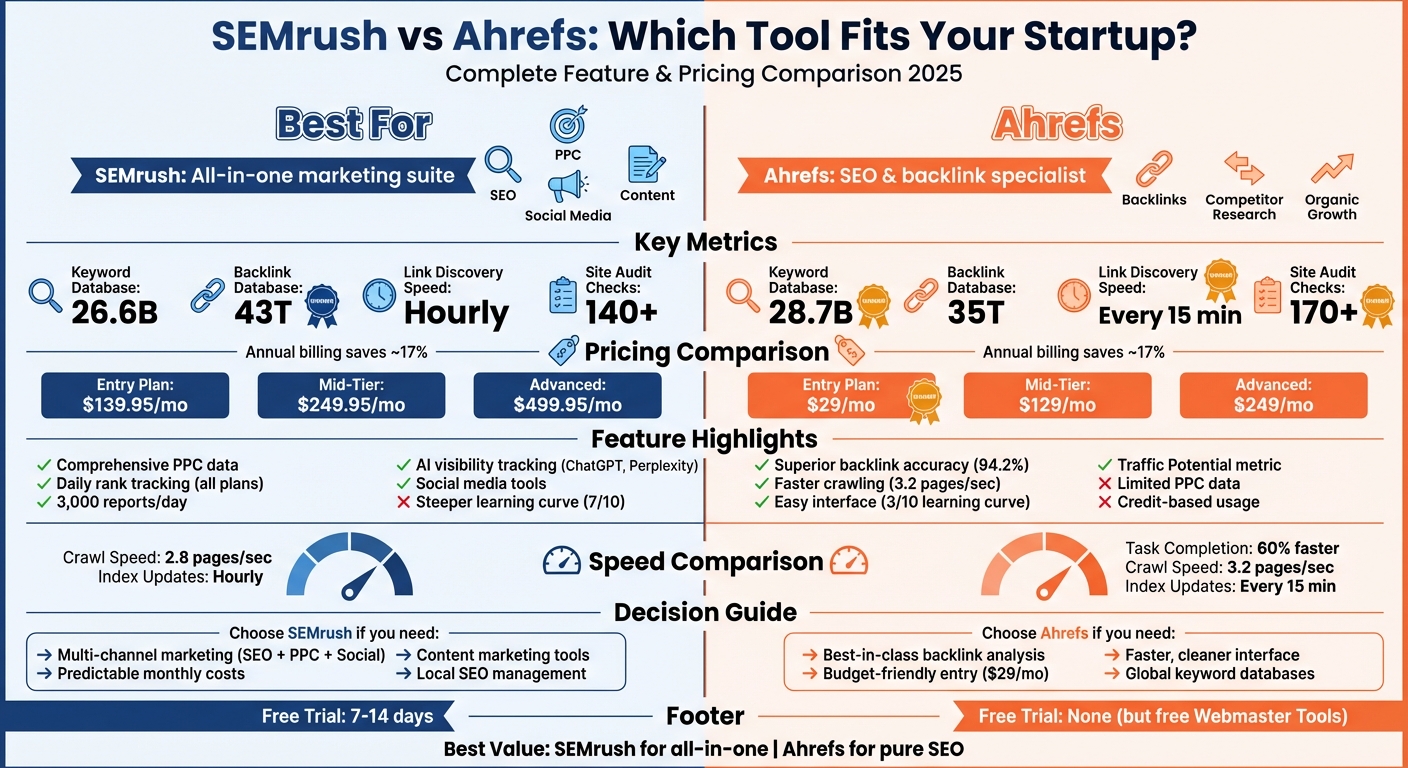
SEMrush vs Ahrefs: Complete Feature and Pricing Comparison for Startups
SEMrush: Features and Benefits for Startups
Main Features for Startups
SEMrush isn’t just an SEO tool - it’s a comprehensive marketing platform. From keyword research to competitive analysis, site audits, PPC advertising, social media, and content marketing, it offers everything startups need in one place. For startups working with tight budgets, this means cutting out multiple subscriptions and managing it all for a starting price of $139.95/month.
One standout feature is the Keyword Magic Tool, which boasts a massive 26.6-billion keyword database, including 3.6 billion keywords specific to the U.S. It also includes a Personal Keyword Difficulty (PKD%) metric, making it easier for startups to find low-competition opportunities to target early on in their growth journey.
The Site Audit tool is another game-changer, scanning for over 140 technical and on-page SEO issues. It categorizes them as Errors, Warnings, or Notices, helping startups prioritize what needs fixing first. There’s even an AI Search category to ensure your site stays visible on emerging generative search platforms. For competitive analysis, tools like Keyword Gap and Backlink Gap allow you to compare your site with up to five competitors, helping you uncover opportunities in both content and link-building strategies.
SEMrush also tracks over 49 SERP features and monitors a staggering database of 43 trillion backlinks, giving startups a robust foundation for scaling their marketing efforts.
How SEMrush Helps SaaS Startups Scale
SEMrush’s features are designed to deliver measurable results, particularly in helping SaaS startups reduce customer acquisition costs by leveraging organic search. The platform itself drives 3.2 million monthly visitors - traffic that would cost an estimated $4 million if acquired through PPC.
For content creation, tools like Topic Finder and SEO Writing Assistant are invaluable. They help teams quickly identify data-driven topics that address user pain points while providing real-time feedback on SEO, readability, and tone. These tools integrate seamlessly with platforms like Google Docs and WordPress, making them ideal for fast-paced teams.
"If you ask an agency to deliver 10x organic search growth through content, they will assign a large team to your project. Our content team, in contrast, runs activities with Semrush without having an army of people specialized in SEO."
– Fabrizio Ballarini, Responsible for SEO, Wise
In addition to organic search, SEMrush’s advertising toolkit helps startups analyze competitor ad budgets, uncover seasonal trends, and refine ad copy for better PPC performance. The platform also monitors how your brand appears in AI-generated responses across tools like ChatGPT, Perplexity, and Google AI Overviews - a critical feature when the top three Google results capture 54.4% of all clicks.
Whether it’s organic traffic, PPC, or staying ahead in AI-driven search, SEMrush equips startups with the tools they need to grow efficiently.
Ahrefs: Features and Benefits for Startups
Main Features for Startups
Ahrefs is a laser-focused SEO tool that specializes in competitive research, making it a go-to resource for startups aiming to refine their strategies. Its Site Explorer provides an in-depth look at competitors' organic traffic, backlink profiles, and best-performing pages, giving you the insights needed to replicate their success.
One standout tool is Content Explorer, which scans a massive database of over 11 billion pages. It helps uncover content ideas that perform well and identifies topics likely to attract backlinks naturally. The Keywords Explorer takes it a step further by using clickstream data to reveal low-competition, long-tail keywords based on real user behavior.
For link-building, the Link Intersect tool identifies sites linking to your competitors but not to you, offering pre-qualified targets for outreach. Meanwhile, the Site Audit tool simulates a Googlebot crawl, flagging issues like broken links, redirects, and other technical problems in an easy-to-understand format - no advanced technical skills required.
Ahrefs also boasts an enormous backlink index with over 35 trillion links across 200 million unique domains. Its crawler processes 8 billion pages daily, and updates its index every 15 minutes, often spotting new backlinks 24–48 hours faster than competitors. The Domain Rating (DR) metric, which scores backlink profile strength on a 0–100 scale, is widely recognized as a reliable benchmark for tracking your market position. Together, these tools provide the precision needed to execute effective SEO strategies.
How Ahrefs Supports Startup Growth
Ahrefs equips startups with accurate, actionable data to fuel growth. By focusing on data quality rather than overwhelming users with features, it enables startups to achieve measurable results. With a database of 28 billion keywords spanning over 200 countries, Ahrefs ensures that the insights you gain are not only extensive but also trustworthy.
"Ahrefs is my default when the core job is SEO research and prioritization. Its backlink data, keyword difficulty signals, and content gap analysis feel tighter and less noisy."
– Sonu Goswami, SaaS Content Writer
For link-building, Ahrefs allows you to monitor competitors' backlinks in near real-time. This helps you spot broken link opportunities and replicate successful outreach strategies. The Content Gap analysis pinpoints keywords your competitors rank for but you don’t, giving you a clear roadmap for expanding your content.
"My team and I live in Ahrefs because it helps us answer the questions that actually move the needle: who's ranking, why they're ranking, and what it would realistically take to outrank them."
– Andre Oentoro, CEO, Breadnbeyond
Ahrefs' Traffic Potential metric is another game-changer. Unlike standard search volume, it estimates the total traffic a page could generate across all keyword variations. This keeps startups from chasing "vanity" keywords that look impressive but don’t drive meaningful results. Starting at $29/month for the Starter plan and $99/month for the Lite plan, Ahrefs offers an affordable and scalable solution for startups working within tight budgets.
Feature Comparison: SEMrush vs Ahrefs
Comparison Table
Both SEMrush and Ahrefs bring strong SEO tools to the table, but they cater to slightly different needs. SEMrush positions itself as a comprehensive marketing suite, while Ahrefs zeroes in on backlink analysis and competitor research. Here's a side-by-side look at how they compare across key features startups often prioritize:
| Feature | SEMrush | Ahrefs | Advantage |
|---|---|---|---|
| Keyword Database | 26.7 billion keywords | 28.7 billion keywords | Ahrefs (global reach) |
| Backlink Database | 43 trillion links | 35 trillion links | SEMrush (volume) |
| New Link Discovery | Hourly updates | 15-minute updates; 24–48 hours faster | Ahrefs (speed) |
| Site Audit Checks | 140+ technical checks | 170+ parameters | Ahrefs (depth) |
| Daily Rank Tracking | Included in all plans | Limited to higher tiers or paid add-ons | SEMrush (value) |
| PPC/Ad Data | Comprehensive ad history and CPC | Basic/Limited | SEMrush (paid campaigns) |
| Ease of Use | Steeper learning curve | Clean, intuitive interface | Ahrefs (onboarding) |
| Pricing Model | Fixed monthly limits | Credit-based usage | SEMrush (predictability) |
SEMrush is your go-to if you’re juggling multiple marketing channels. It offers over 140 technical checks, including advanced tools like log file analysis and an AI-powered visibility score. It also tracks rankings across platforms like Google, Bing, Baidu, and even ChatGPT, making it a solid choice for startups exploring diverse traffic sources.
Ahrefs, on the other hand, stands out for its speed and accuracy. Its crawler handles 8 billion pages daily and provides updates every 15 minutes. The Content Gap tool is a game-changer for SaaS startups targeting high-intent keywords like "competitor alternatives". Plus, its "always-on" crawling feature monitors your site minute-by-minute, something SEMrush doesn’t currently offer.
Pros and Cons for Startups
To help you decide, here’s a closer look at what each platform brings to the table - and where they might fall short.
SEMrush Pros:
SEMrush’s all-in-one approach eliminates the need for separate tools for PPC, social media, or content marketing. Its SEO Writing Assistant integrates seamlessly with platforms like Google Docs and WordPress, allowing real-time content optimization. Daily rank tracking is included in all plans, and the Keyword Strategy Builder simplifies topic clustering. For startups managing multiple campaigns, this can save both time and money.
SEMrush Cons:
The interface can be overwhelming - some users liken it to sitting in an airplane cockpit. The steep learning curve might slow down teams looking for quick wins. At $139.95/month for the Pro plan, it’s also more expensive than Ahrefs’ entry-level options.
Ahrefs Pros:
Ahrefs boasts an easy-to-use interface, and its backlink data is often regarded as the most accurate in the industry. The Traffic Potential metric helps startups avoid wasting time on keywords that won’t deliver results. At just $29/month for the Starter plan, it’s an affordable option for bootstrapped teams. For SaaS startups looking to grow quickly, Ahrefs offers both speed and precision.
Ahrefs Cons:
The credit-based pricing model can be frustrating - every action consumes credits, making it hard to predict monthly costs. It lacks a built-in outreach tool for link building, requiring third-party platforms like Pitchbox. Additionally, its PPC data is limited, which makes it less useful if you’re running paid campaigns alongside organic efforts.
"Choose Semrush if you need an all-in-one digital marketing suite with content marketing, PPC, and social media tools. Choose Ahrefs if backlink analysis and competitor research are your primary focus." – Nick, CEO & Founder, SEOmator
Next, we’ll dive into pricing to help you determine which tool offers the best value for your specific needs.
Pricing: SEMrush vs Ahrefs
Pricing Table
Pricing can be a game-changer for startups, especially when budgets are tight. Both SEMrush and Ahrefs made updates to their pricing in 2025–2026, with SEMrush introducing the Semrush One suite in October 2025. Meanwhile, Ahrefs has maintained a lower-cost entry option. Here's a breakdown of their pricing:
| Plan Tier | Ahrefs (Monthly) | SEMrush (Monthly) | SEMrush (Annual/mo) |
|---|---|---|---|
| Entry/Starter | $29.00 (Starter) | $139.95 (Pro) / $199.00 (One Starter) | $117.33 / $165.17 |
| Mid-Tier | $129.00 (Lite) | $249.95 (Guru) / $299.00 (One Pro+) | $208.33 / $248.17 |
| Advanced | $249.00 (Standard) | $499.95 (Business) / $549.00 (One Advanced) | $416.66 / $455.67 |
| Enterprise | $1,499.00+ | Custom | Custom |
The platforms also differ in how they handle usage limits. For example, SEMrush's Pro plan supports up to 3,000 reports per day, while Ahrefs Lite offers only 500 credits per month. This makes SEMrush a better choice for intensive research. SEMrush sweetens the deal with a 7-day free trial (extendable to 14 days through partner links). On the other hand, Ahrefs doesn’t offer trials or discounts but does provide free access to Ahrefs Webmaster Tools for verified site owners.
Opting for annual billing with SEMrush can save you about 17%, bringing the monthly cost of the Semrush One Starter plan down to $165.17 from $199.00. Ahrefs Lite, when billed annually, averages about $83.00 per month. Keep in mind that both platforms charge extra for additional users, with fees ranging from $40.00 to $100.00 per month. These pricing variations are important when deciding which tool aligns with your startup's budget and needs.
Best Value for Startups
The pricing comparison underscores how each platform serves different startup scenarios. Choosing the right plan depends on balancing affordability with the scope of features.
For solo entrepreneurs or startups working with tight budgets, Ahrefs' Starter plan at $29.00 per month is a solid entry-level option. As Victoria Kurichenko, SEO Specialist and Founder of Self Made Millennials, notes:
"My go-to Ahrefs plan is the Starter plan at $29/month. It includes Site Explorer, Keywords Explorer, and Site Audit, which makes it perfect for beginners, startups, and solopreneurs looking for an affordable SEO solution."
For startups managing multiple marketing channels, SEMrush offers a broader range of tools. Brian Dean, Founder of Backlinko, explains:
"When it comes to pure value, Semrush wins. That's mostly because you get a fully-featured SEO software suite AND Google Ads software for the same monthly price."
The Semrush One Starter plan ($199.00 per month) includes the AI Visibility Toolkit, which monitors brand mentions across platforms like ChatGPT, Perplexity, and Google AI Overviews. This feature is increasingly relevant as AI-driven answers now appear in 86.83% of all searches.
For startups conducting high-volume research, SEMrush's allowance of 3,000 daily reports far exceeds Ahrefs' credit-based system. However, be aware of extra costs: Ahrefs credits can run out quickly during in-depth competitor analysis, and SEMrush charges for certain add-ons like Local SEO ($30.00 per month). A smart strategy might involve combining tools - using Ahrefs Webmaster Tools for free technical audits while leveraging SEMrush's trial period for broader SEO tasks.
Usability and User Experience
Ease of Use
The interface you choose can make or break your startup's productivity. Ahrefs keeps things simple with a clean, efficient design and a relatively shallow learning curve, rated 3/10. This makes it a great choice for teams that need to get up to speed quickly. Isabella Rossi, CPO at Fruzo, describes her experience:
"Ahrefs delivers a more focused and reliable experience... This utilitarian design... allows me to get answers quickly and trust that the insights closely reflect reality."
On the other hand, SEMrush offers a more complex setup, packing over 40 marketing tools into a single dashboard. It's more like a "Marketing OS" than a standalone tool, which comes with a steeper learning curve of 7/10. This complexity can feel daunting for beginners, but SEMrush compensates with detailed explanations and educational resources. For instance, while Ahrefs highlights technical issues clearly, SEMrush goes a step further by providing guided, step-by-step instructions to help users resolve them.
Both tools aim to simplify SEO tasks, but their approaches differ. Ahrefs excels in speed and clarity, while SEMrush focuses on offering a deep, feature-rich experience.
Integration and Workflow
Beyond ease of use, how well a tool integrates with your existing workflow can greatly impact efficiency. SEMrush serves as an all-in-one command center, integrating seamlessly with platforms like Google Ads, HubSpot, Shopify, and Looker Studio. Its SEO Writing Assistant even works directly within Google Docs, WordPress, and Microsoft Word. This allows content teams to optimize articles in real time without jumping between platforms.
Ahrefs, on the other hand, operates more like a specialized research tool. It integrates closely with Google Search Console and Google Sheets, but extending its functionality often requires manual effort. That said, teams that rely on specialized tools appreciate how easily Ahrefs exports data into existing reporting workflows. Plus, it’s about 60% faster at completing core SEO tasks, which can be a game-changer when working under tight deadlines. David Hunt, COO at Versys Media, sums it up well:
"Ahrefs is our scalpel for serious backlink and competitive organic research. Semrush is our Swiss army knife for ongoing site health, campaign planning and reporting to non-technical stakeholders."
Which Tool Should Your Startup Choose?
Main Takeaways
SEMrush serves as an all-in-one marketing dashboard, combining SEO, PPC, content creation, and social media management. With a database tracking 26.6 billion keywords and 43 trillion backlinks, plus monitoring of 49+ SERP features, it offers extensive capabilities. At $139.95 per month for the Pro plan, it provides higher reporting limits compared to similar Ahrefs plans. These differences make it well-suited for certain use cases, as outlined below.
Ahrefs, on the other hand, excels in backlink analysis and technical SEO. It boasts an impressive 94.2% accuracy in keyword difficulty predictions and crawls at 3.2 pages per second, slightly faster than SEMrush's 2.8 pages per second. Its streamlined interface is often preferred over SEMrush's feature-packed dashboard, making it easier to navigate for many users.
When it comes to AI visibility tracking, SEMrush integrates directly with tools like ChatGPT, Google AI Overviews, Perplexity, and Gemini. Ahrefs offers similar functionality but only through its separate Brand Radar add-on, which costs $199 per month.
Recommendations by Startup Goals
Your choice between SEMrush and Ahrefs ultimately depends on your startup's specific goals and priorities.
Pick SEMrush if you're balancing paid search campaigns with organic growth. Fabrizio Ballarini from Wise shared how his team achieved "10x organic search growth" using SEMrush's integrated workflows - all without increasing their SEO team size. Its Personalized Keyword Difficulty tool, which tailors insights based on your domain authority, is particularly helpful for smaller teams looking to maximize efficiency. Additionally, SEMrush's Listing Management tools make it ideal for businesses with physical locations.
Go with Ahrefs if backlinks are central to your growth strategy or you're managing multiple domains. Its ability to track unlimited domains on paid plans makes it a strong choice for agencies or startups with multiple websites. Sonu Goswami highlights:
"Ahrefs is my default when the core job is SEO research and prioritization. Its backlink data, keyword difficulty signals, and content gap analysis feel tighter and less noisy".
For SaaS companies in competitive industries like FinTech, where analyzing competitor link profiles is critical, Ahrefs' Link Intersect reports provide the detailed insights needed to stay ahead.
If you're working with a tight budget and need extensive reporting, SEMrush's more generous limits can be a cost-effective option. However, for startups operating across global markets and relying less on paid ads, Ahrefs' country-specific databases and cleaner data exports may make its credit-based pricing worthwhile despite some added complexity.
Ahrefs vs Semrush (2025) - Which is the Better SEO Tool?
FAQs
Which plan should I start with as a bootstrapped startup?
For a startup operating on a limited budget, opting for the most budget-friendly plan is a smart move. Ahrefs' Starter plan, priced at approximately $29/month, provides essential tools such as backlink analysis, keyword research, and site audits. This plan covers the basics of SEO, allowing you to tackle important tasks without stretching your finances. Plus, as your business grows and your requirements expand, you can always consider upgrading.
How do I avoid hitting usage limits (reports or credits)?
To keep from exceeding usage limits, it’s a good idea to keep an eye on your plan’s allowances and track how much you’re using. You can manage your activity by setting limits on things like daily or weekly reports and planning your tasks in advance. If you find your current plan isn’t enough, consider upgrading to one with higher limits to avoid overage charges. Make it a habit to review your usage stats so you can tweak your workflow or adjust your plan as needed.
Can I use both tools together without duplicating work?
Yes, using SEMrush and Ahrefs together can be highly effective since their features complement each other. SEMrush shines in areas like content marketing, PPC campaigns, and social media management, while Ahrefs is particularly strong in backlink analysis and keyword research. By combining tools like SEMrush’s PPC insights with Ahrefs’ backlink data, you can build a well-rounded SEO strategy without overlapping efforts.